
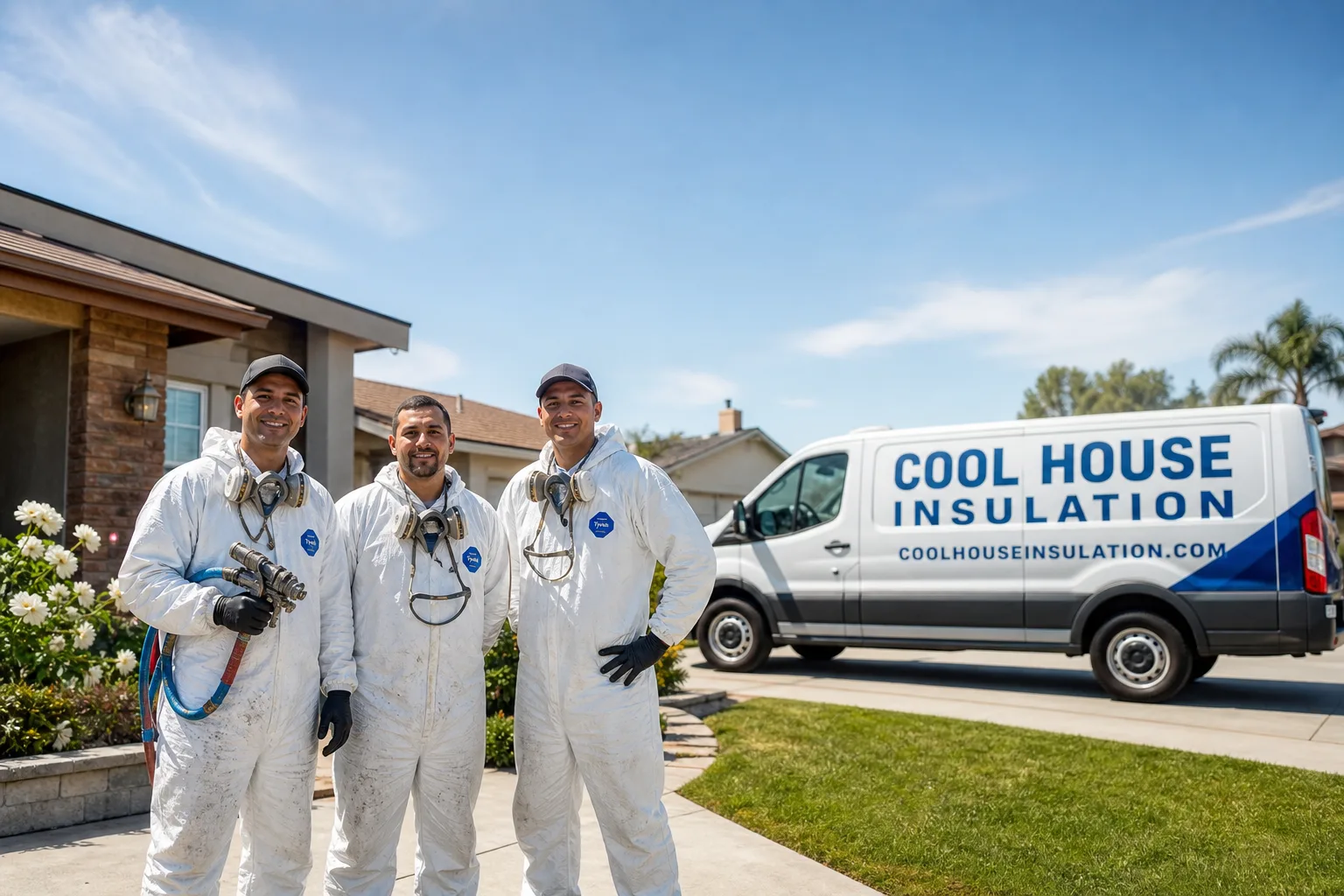
Fast, Reliable Spray Foam Insulation Across Signal Hill
Spray foam insulation in Signal Hill typically runs $2.50 – $6.50 per board foot depending on whether you need open-cell or closed-cell, and most homes fall between $2,800 and $9,000 for a full attic or wall project. We respond to Signal Hill calls within 24 hours for estimates, often same-day for emergencies like exposed wall cavities after a remodel. This small city sits entirely inside Long Beach’s borders, built over one of the most productive oil fields in California, and that changes how insulation gets done here. Call (855) 341-7810 and we’ll walk you through what your specific house actually needs.
Why Cool House Insulation Is Signal Hill’s Preferred Spray Foam Insulation Company
Noel Carrasco has spent years working insulation jobs across Los Angeles and Orange County, and Signal Hill keeps throwing him curveballs most contractors never see. Pumpjacks operating in backyards. Cottages from the 1930s that have never held insulation. Flat roofs where standard attic work doesn’t apply. Our crew knows what those jobs demand because we’ve done them.
Signal Hill homeowners call us because we carry both Icynene and Demilec spray foam systems, which means we’re not stuck recommending one product for every house. A 1940s bungalow off Temple Avenue needs something different than a newer hillside home above the 405. We match the foam to the framing, the roof pitch, and the way the ground moves underneath. That’s the difference between an estimate from someone who’s worked in Signal Hill and one from a company that just plugs your address into a calculator.
Our local reputation comes from showing up prepared. We know the streets around Discovery Well Park, we know what the marine layer does to open-cell foam, and we know which houses on the hill still have knob-and-tube wiring behind the walls. The city’s building history is visible in every block. So is our work.
Spray Foam Attic Insulation in Signal Hill
Spray foam attic insulation is our most common job in Signal Hill because so many older homes here have low-pitch roofs, no attic access, or crawl spaces too tight for batts. In the oil-worker cottages south of Hill Street, attics are often just 12 to 18 inches of cavity under a flat roof. Closed-cell foam applied to the underside of the roof deck seals that space, blocks radiant heat from Southland sun, and adds structural rigidity to framing that seismic activity and oil-field subsidence have already stressed. Expect to pay $3,200 – $7,500 for a typical Signal Hill attic depending on square footage and foam depth.
Flat and Low-Slope Roof Decks
Flat roofs dominate the older blocks of Signal Hill. When there’s no vented attic, you can’t blow in fiberglass and call it done. Closed-cell Demilec foam sprayed directly to the roof deck creates an unvented assembly that keeps marine moisture from condensing inside the framing. For homes where the decking is too compromised for closed-cell, we’ll recommend open-cell in the wall cavities instead and leave the roof assembly alone.
Attics Over Active Knob-and-Tube
Spray foam should never be applied over live knob-and-tube wiring. The foam acts as a thermal blanket, and those old conductors weren’t designed to shed heat that way. We flag it during every estimate in Signal Hill’s pre-1950 stock. Once an electrician clears or replaces the wiring, we come back and spray. That’s the only order that passes inspection and keeps the house safe.
Spray Foam Wall Insulation in Signal Hill
Spray foam wall insulation in Signal Hill usually means drilling into plaster and lathe walls on 1920s – 1950s bungalows and injecting foam into cavities that were never filled. Those oil-worker cottages were built fast and cheap, with no insulation in the walls at all. Open-cell Icynene works well here because it expands gently, fills irregular stud bays, and won’t crack like rigid board when the ground settles. Typical wall insulation for these homes runs $3,800 – $9,800 depending on the number of exterior walls and whether we’re working from inside or outside.
Legacy Framing Cavities
Old-growth framing in Signal Hill means studs that aren’t exactly 16 inches on center. Some are 19. Some are 24. Some walls have diagonal bracing or let-in blocking. Foam fills those gaps completely, which fiberglass batts never will. That’s the whole reason we recommend spray foam over blown-in for the older cottages here.
Subsidence and Cracked Foam
Ground movement from the oil field is real. Over decades, homes shift. Rigid closed-cell foam installed in wall corners can crack under that stress, breaking the air seal. Open-cell foam flexes. For most Signal Hill walls, that makes open-cell the smarter specification unless there’s a moisture concern that demands closed-cell’s vapor resistance. We’ll explain the tradeoff in plain terms before you spend a dollar.
Trusted Brands We Service in Signal Hill
We’re factory-authorized to install Spray Foam Insulation from Icynene and Demilec, which gives Signal Hill homeowners access to both open-cell and closed-cell chemistry from the two most respected names in foam performance. We also work with Rockwool and CertainTeed when a mineral wool or hybrid approach makes more sense for a specific wall or roof assembly. Our service van carries the consumables we need for most Signal Hill jobs, and anything special gets sourced within a day or two from our La Palma shop. You’re never waiting on a single-brand distributor’s schedule.
Common Spray Foam Insulation Problems We See in Signal Hill Homes
- Foam over active knob-and-tube wiring. Pre-1950 cottages throughout the 90755 zip code still carry original electrical. Foam over live conductors traps heat and fails inspection. Rewiring comes first, always.
- Cracked closed-cell foam at wall corners. Oil-field subsidence creates hairline movement in old framing. Rigid foam can’t flex with it, and the air seal breaks. We recommend open-cell in most legacy walls.
- Moisture trapped under flat roofs. The marine layer pushes damp air against low-slope roof decks. Improperly installed foam seals that moisture in, rotting sheathing from the inside. Correct depth and curing matter.
- Uninsulated oil-worker cottages. Many Signal Hill homes built between 1920 and 1950 have zero wall insulation. The fix isn’t fiberglass in the attic. It’s foam in the wall cavities, and it changes comfort overnight.
Pricing for Spray Foam Insulation in Signal Hill, CA
Open-cell spray foam in Signal Hill runs $1.80 – $3.20 per board foot installed. Closed-cell runs $3.50 – $6.50 per board foot. A full attic spray on a 1,200-square-foot bungalow typically lands between $3,000 and $6,800. Whole-wall retrofits on those same 1920s – 1950s homes usually fall between $4,200 and $9,500. The big variables are access (flat roofs with no attic hatch cost more to reach), wiring condition, and whether we’re matching existing foam or starting fresh. We give free estimates with line-item breakdowns so you know exactly what you’re paying for. Call (855) 341-7810 and we’ll schedule a walkthrough.
We Also Serve Cities Near Signal Hill
Our crew covers all of Signal Hill plus the surrounding communities: Long Beach, Lakewood, Carson, and Hawaiian Gardens. If you’re on the border of any of these, call us anyway. We’ll tell you straight up whether we can get there this week.
Serving Signal Hill, CA — Our Local Coverage Area
We’re based in the Signal Hill area and know this community well. Use the map below to see our service coverage — if you’re nearby, we can almost certainly help.
FAQs About Spray Foam Insulation in Signal Hill
No. Spray foam should never touch live knob-and-tube wiring. The foam insulates the conductors and traps heat, which creates a fire hazard and fails inspection. Every pre-1950 home in Signal Hill gets a wiring check before we quote foam. If the wiring is still active, we’ll recommend an electrician first, then come back to spray. Call (855) 341-7810 for a walkthrough that includes the wiring check.
The oil field underneath Signal Hill causes slow ground movement, and older homes shift with it. That movement cracks rigid closed-cell foam at corners and around window openings over time. For most legacy walls, we specify open-cell foam, which flexes without losing its air seal. The oil field also means easements and pumpjacks near property lines, so access planning matters more here than in neighboring tract subdivisions.
Yes, and in many cases it’s the only practical insulation method. Flat roofs on 1920s – 1950s bungalows rarely have vented attics, so batts and blown-in can’t work. Closed-cell foam sprayed to the underside of the roof deck creates an unvented assembly that blocks radiant heat, resists marine moisture, and adds rigidity to aging framing. We’ve done this on homes throughout the 90755 zip code, including several near Temple Avenue with no attic access at all.
Open-cell foam is vapor-permeable, so it lets moisture pass through rather than trapping it. That’s usually the right call for walls in a coastal climate with regular marine layer exposure. Closed-cell foam is a vapor barrier and adds structural strength, which helps on flat roof decks and in areas where you need R-value per inch. For most Signal Hill wall cavities and the underside of flat roofs, we pair open-cell in the walls with closed-cell at the roof deck. It’s application-specific, not one-product-fits-all. Call (855) 341-7810 and we’ll tell you which your house needs.
It depends on what’s already there. Fiberglass batts that are compressed, moldy, or mouse-damaged should come out before we spray. Old rock wool or cellulose in decent shape can stay in place if it’s not blocking airflow or hiding wiring issues. The real retrofit question in Signal Hill is wiring and roof condition, not old insulation. We’ll assess that during your free estimate and give you a straight answer. Call (855) 341-7810 to schedule it.
Understanding Signal Hill’s Oil-Field Legacy Before You Insulate
Signal Hill is a 2.2-square-mile city entirely surrounded by Long Beach, built directly over an oil field that’s still producing. Hundreds of pumpjacks operate within feet of homes, in backyards, next to parks, alongside quiet residential streets. The housing stock reflects that history. Homes built during the 1920s – 1950s oil boom went up fast, for workers who needed shelter close to the rigs. Those cottages were never insulated. The walls are empty. The roofs are flat or low-slope because that was the cheapest way to build. The ground moves, because the field does.
On a 1940s oil-worker cottage near the intersection of Hill Street and Temple Avenue, we found original knob-and-tube wiring in uninsulated wall cavities and a flat roof with no attic access. After rewiring was cleared, our crew sprayed Icynene open-cell foam into the wall cavities and closed the roof deck from below, sealing drafts and blocking radiant heat. The homeowner reported a noticeably cooler upstairs bedroom and lower summer bills, all without disturbing the pumpjack easement at the property line.
That’s Signal Hill insulation. You plan for the ground and the old stock, not just the attic. Spray foam is often the only viable method for these homes, because the cavities are irregular, the roofs are unvented, and the framing has been settling for seventy years. We treat every Signal Hill estimate as a retrofit diagnosis, not a product pitch. The foam is the tool. The goal is a house that finally holds its temperature.
Written by Noel Carrasco, Owner at Cool House Insulation, serving Signal Hill and surrounding communities.