
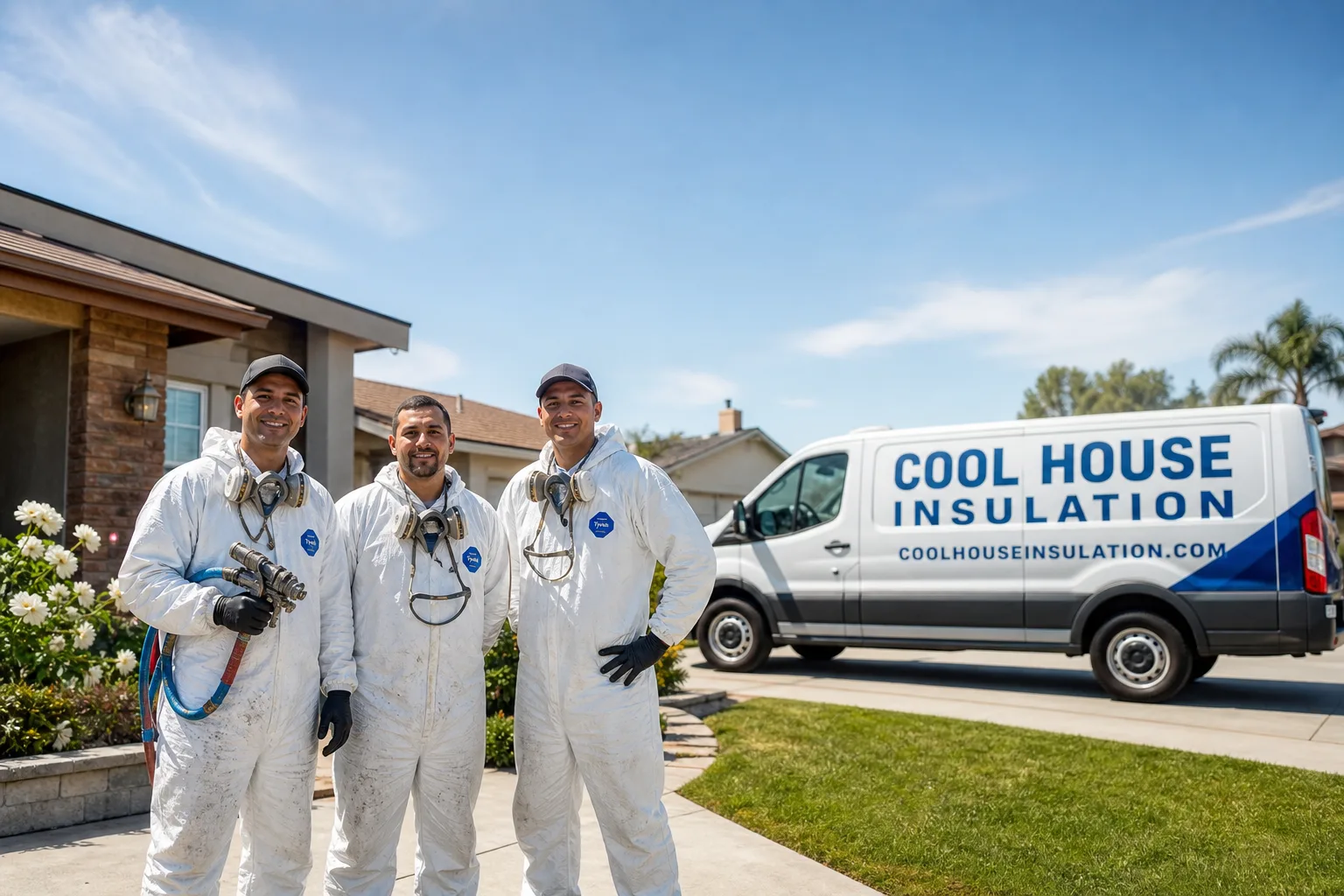
Fast, Reliable Spray Foam Insulation Across West Covina
Spray foam insulation in West Covina is the most effective way to stop radiant attic heat from baking your ceilings, because this city sits in the inland San Gabriel Valley where summer highs regularly push past 100°F. Most West Covina homes were built between 1948 and 1972, and the attics above them still carry the original builder-grade insulation, compressed flat and barely doing R-11 to R-19 work. We install open-cell and closed-cell spray foam throughout the 91790, 91791, 91792, and 91793 ZIP codes, and we know exactly what these tract homes need. Call (855) 341-7810 for a free estimate.
Why Cool House Insulation Is West Covina’s Preferred Spray Foam Insulation Company
We work across eight insulation brands, which means when you call us about a West Covina attic, we’re not slotting you into whatever one product we happen to carry. We carry Icynene and Demilec for spray foam specifically. Those are two of the most respected names in open- and closed-cell performance, and we’re authorized to install both. If foam isn’t the right call for your home, we’ll tell you that too, because we also handle Rockwool batts and GreenFiber blown-in. The recommendation follows the house, not our inventory.
Noel Carrasco leads our crews, and the team’s time in the field across the San Gabriel Valley means we’ve walked the same attics you’d find in West Covina hundreds of times. We know how the low-pitch roofs in the older tracts limit working clearance. We know how attached garages on these lots bleed heat into adjacent rooms. That familiarity changes how we bid the job and how we execute it. Homeowners in West Covina call us because they want a straight answer about what’s failing up there, not a sales pitch from someone who’s never been in a 1962 attic on a 105°F day.
Response time to West Covina from our La Palma shop is typically same-week for quotes and scheduling, with faster turnaround for urgent attic or garage jobs before summer really starts baking. This area is a routine service zone for us, not a distant afterthought.
Garage Spray Foam Insulation in West Covina
Garage Spray Foam Insulation is one of the most requested services we do in West Covina, and it’s not hard to see why. The postwar tracts here feature attached garages with unfinished ceilings that sit directly below or beside living spaces. On an August afternoon in the 91790 ZIP, the air in those garage cavities crosses 120°F, and that heat pushes through the stud bays into whatever room shares the wall. West Covina homeowners call us when they notice the bedroom over the garage simply won’t cool down, no matter how hard the HVAC runs.
We apply closed-cell foam to the garage ceiling and rim joists, sealing the cavity so heat stops conducting through. The foam also quiets street noise from busy roads like Amar Road or Merced Avenue. For detached garages and workshops on larger West Covina lots, open-cell foam is often the better fit, especially if the building is purely a workspace and doesn’t need vapor control the way an attached garage does.
A typical garage ceiling spray foam job in West Covina runs between $950 and $2,400 depending on square footage and whether we’re also sealing the rim joists. Call (855) 341-7810 and we’ll come measure it properly.
Attached Garage Ceilings and the Heat-Bleed Problem
The heat path isn’t always obvious from inside the garage. The drywall ceiling looks fine. But above it, the only thing separating your cooled living space from a 130°F cavity is often a thin batt that slid out of place decades ago. We foam the garage side because that’s where the heat actually enters. Once closed-cell foam seals the ceiling plane, the rooms above and beside the garage stop fighting the thermal load.
Detached Workshops and Oversized Garages
West Covina’s zoning has allowed detached workshops and oversized garages on many of its larger lots, which means we see a lot of second buildings that were never insulated at all. If you work in one of those buildings during the summer, you already know how fast it turns into a convection oven. Open-cell spray foam on the walls and roof deck drops interior temperature dramatically and keeps dust down too, because it seals the gaps where the wind used to push through.
Closed Cell Spray Foam Insulation in West Covina
Closed Cell Spray Foam Insulation is the go-to for West Covina attics that are chronically hot, because this material does two things at once: it insulates and it air-seals. The tract homes here mostly have low-pitch roofs with shallow attic clearance, and the original batts sit directly on the ceiling plane with nothing stopping 140°F attic air from cooking the living space below. Closed-cell foam applied to the roof deck turns that hot zone into a conditioned envelope, and because it’s a vapor barrier on its own, it also prevents the moisture buildup that can happen when someone sprays the wrong material in a tight old attic.
We recommend closed-cell for most West Covina homeowners with standard 1950s to 1970s tract construction. The R-value per inch is roughly double what the original builder insulation provided, and the air-sealing effect is what really moves the needle when outside temperatures are above 95°F for weeks at a time. For homes in the 91791 and 91792 areas near the hills where afternoon sun hits harder, closed-cell on the roof deck is often the single most effective change you can make.
Closed-cell spray foam in a West Covina attic typically runs $2,800 to $5,600 for a standard single-story tract home roof deck. Call (855) 341-7810 for a measured quote, no guessing.
Roof Deck Applications for Low-Pitch Tract Homes
Most West Covina homes have a roof pitch shallow enough that walking the attic floor means crouching under rafters. Installing batts cleanly in that space is nearly impossible, which is one more reason the old insulation fails. We spray directly onto the underside of that roof deck, so the foam follows the geometry of the roof regardless of slope. The result is a full, continuous thermal envelope with no gaps.
Air Sealing and the 105°F Afternoon Problem
When it’s 105°F outside, the air in a West Covina attic can reach 145°F or more. That superheated air infiltrates through ceiling penetrations, recessed light housings, and the gaps around framing. Traditional batts only slow that transfer; they don’t stop it. Closed-cell foam stops it, because it creates a continuous air barrier. That’s the difference between an attic that’s merely insulated and one that’s actually sealed.
Trusted Brands We Service in West Covina
We stock and install spray foam from Icynene and Demilec, two manufacturers whose products consistently perform in high-heat attics like the ones we treat throughout West Covina. Our crews are also trained on Spray Foam Insulation systems from multiple manufacturers, so we’re never trying to sell you the only foam we happen to know how to use. For homeowners considering alternatives, we also carry Rockwool mineral wool and CertainTeed batt products. The right material for a 1960s tract home off Azusa Avenue might not be the right material for a hillside home in the 91791 ZIP, and we stock enough variety to make the call honestly.
Common Spray Foam Insulation Problems We See in West Covina Homes
- Collapsed original batts in post-war attics. The builder-grade insulation in many West Covina homes has been compressed flat by decades of foot traffic and gravity. Once it sags away from the joists, the ceiling below becomes a direct radiator for 140°F attic air.
- Attached garages dumping heat into adjacent rooms. The uninsulated garage ceiling is a consistent Achilles heel in West Covina’s tract layouts. We foam the garage side to close that heat path before it gets into the wall cavities.
- Low-pitch roofs with tight attic clearances. The original construction didn’t leave much room for anything beyond a thin batt. If you try to add more batts in that space, they usually block the eave vents and create moisture problems. Spray foam on the roof deck avoids that entirely.
- Detached workshops and oversized garages never insulated at all. Many West Covina lots include a standalone building that sits uninsulated for decades. It becomes a furnace by mid-morning in July, and standard fiberglass often can’t keep up. Open-cell foam handles the job.
Pricing for Spray Foam Insulation in West Covina, CA
Here’s what spray foam work costs in West Covina. Garage ceiling spray foam runs $950 to $2,400. Closed-cell attic roof deck jobs on a typical 1,200 to 1,800 square foot tract home run $2,800 to $5,600. Open-cell spray foam for detached workshops and oversized garages runs $1,800 to $4,200 depending on square footage and whether we’re foaming walls, ceiling, or both. Rim joist spray foam in West Covina homes runs $700 to $1,800.
The largest variables are square footage, whether we’re removing failed batts first, and access difficulty in the tight low-pitch attics this area is known for. Estimates are free. Call (855) 341-7810 and we’ll send someone out to measure the actual spaces you’re trying to cool.
We Also Serve Cities Near West Covina
Beyond our West Covina service area, we run crews to Valinda, South San Jose Hills, La Puente, and Irwindale. The homes in those neighboring communities share the same postwar construction and brutal inland-valley heat patterns, so the same diagnosis-first approach applies. Call (855) 341-7810 to confirm availability in your neighborhood.
Serving West Covina, CA — Our Local Coverage Area
We’re based in the West Covina area and know this community well. Use the map below to see our service coverage — if you’re nearby, we can almost certainly help.
FAQs About Spray Foam Insulation in West Covina
Because most West Covina attics on 1950s to 1970s tract homes are passively vented, and the roof deck absorbs direct sun from roughly 10 a.m. until sunset in summer. On a 100°F day, the air in that attic climbs past 140°F, and the original builder batts, often compressed to an actual R-11, can’t slow that heat enough to matter. The solution is isolating the roof deck from the living space with spray foam, not stacking more material on the ceiling plane. Call (855) 341-7810 and we’ll take a look at what’s actually up there.
Yes. West Covina allows detached workshops and oversized garages on many larger residential lots, and these buildings are almost never insulated. Open-cell spray foam on the walls and roof deck seals the building against both heat and dust, which matters if you use the space for woodworking, auto work, or storage. We’ve foamed detached garages off Workman Avenue and the surrounding streets, and the temperature drop is immediate. Call (855) 341-7810 for a quote on your specific building.
Closed-cell foam stops heat by air-sealing, not just by adding R-value. Traditional batts in a West Covina attic slow heat transfer but allow convection through gaps, so on a 105°F afternoon the ceiling still gets hot. Closed-cell spray foam forms a continuous barrier that prevents superheated attic air from reaching the drywall in the first place. For most West Covina tract homes, the difference between R-19 batts and closed-cell foam is the difference between an upstairs that runs at 81°F and one that holds at 75°F on the same day. Estimates are free at (855) 341-7810.
The main thing is that your garage ceiling is likely a direct heat pathway into adjacent living space, especially in the standard West Covina layouts where a bedroom or family room sits directly above or beside the garage. We remove whatever thin batt is clinging to the ceiling, then apply closed-cell foam to the entire ceiling plane and rim joists. It seals the cavity, blocks the heat, and also cuts road noise from major corridors. Expect to pay between $950 and $2,400 for a standard two-car attached garage in West Covina. Call (855) 341-7810 to schedule a measurement.
If the old batts are compressed, sagging, or contaminated with rodent droppings or decades of dust, they should come out before we spray. In most West Covina tract homes, the original builder insulation is already failing and adds no meaningful thermal value. We remove it, inspect the framing and wiring, then apply foam to the roof deck or ceiling plane. On a recent job off Cameron Avenue in the 91790 ZIP, our crew found rock-wool batts from 1962 sagging away from the roof deck while attic temps hit 145°F. We pulled everything out, sprayed the roof deck and knee walls, and foamed the attached garage ceiling in the same trip. The house stayed under 80°F on a 105°F day. Call (855) 341-7810 if you suspect your attic is in similar shape.
Written by Noel Carrasco, Owner at Cool House Insulation, serving West Covina and the San Gabriel Valley.