
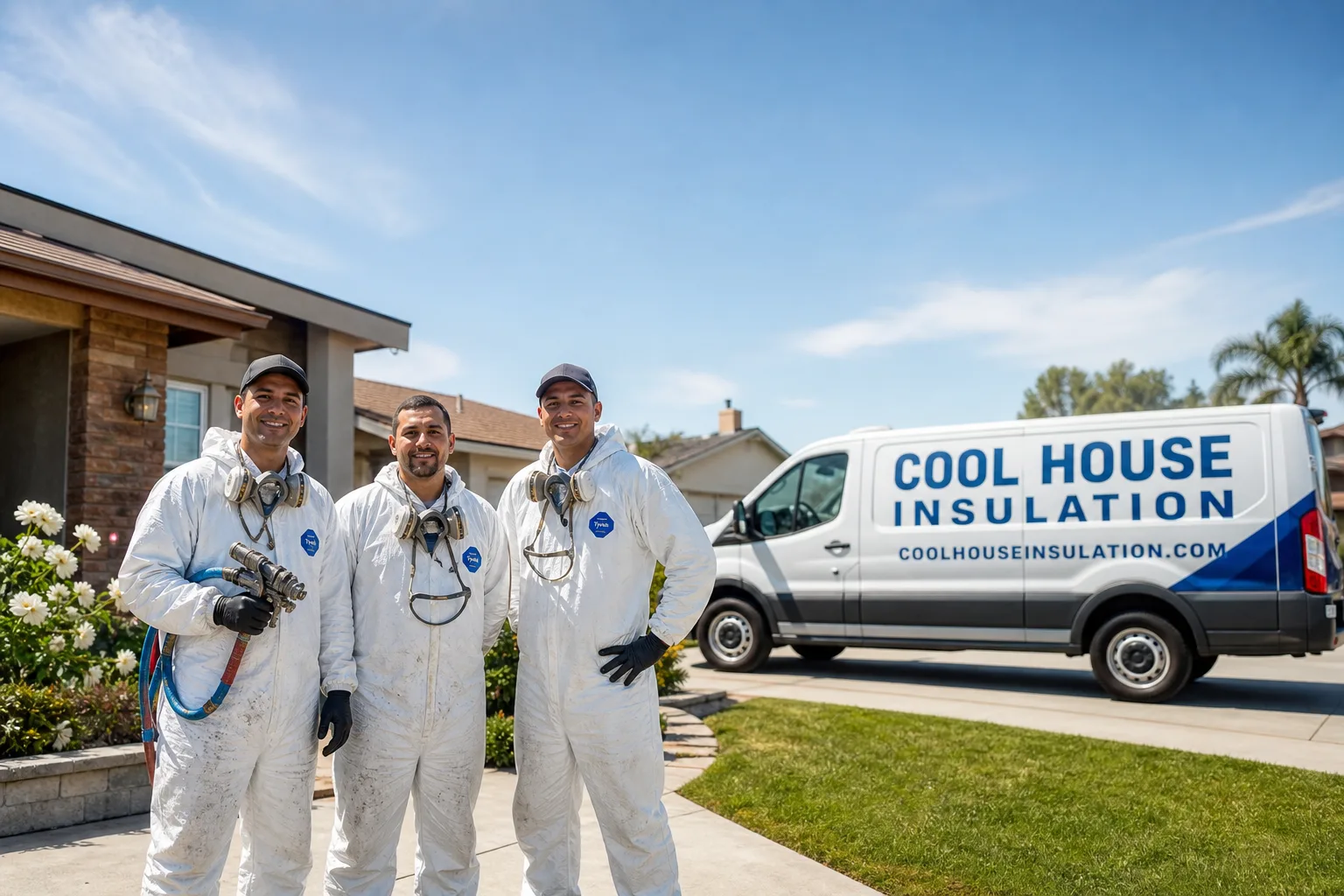
Fast, Reliable Spray Foam Insulation Across Orange
Spray foam insulation in Orange is rarely a simple wall-fill job. In this city, most of the housing stock went up between the 1910s and the 1960s, which means original plaster-and-lath walls, rafter-built attics, and no insulation in places homeowners expect it. Our team knows that reality because we work in Orange’s Old Towne, Plaza, and postwar tract neighborhoods every week, and we shape the scope around what’s actually behind the walls and above the ceiling. If you’re dealing with an attic that turns into an oven by early afternoon or rooms that swing hot and cold through the marine-layer season, give Noel Carrasco and our crew a call at (855) 341-7810 for a straight assessment.
Why Cool House Insulation Is Orange’s Preferred Spray Foam Insulation Company
We solve the problems other insulation crews in Orange walk away from. A 1920s bungalow near the Plaza with plaster-and-lath walls and a rafter-built attic isn’t a simple weekend project, and we’ve done enough of them to know exactly what to check before the first hose gets unrolled. Our customers in Orange’s historic neighborhoods keep referring us because we don’t push wall-fill foam where no cavity exists. We carry both open-cell and closed-cell spray foam, and we match the material to the structure: closed cell for roof decks and rim joists in original attics, open cell where an interior stud wall actually has a cavity worth filling.
Noel Carrasco built this team around one idea: the right insulation for your home, not the only one we carry. We’re authorized installers across multiple manufacturers, including Icynene, Demilec, CertainTeed, and Rockwool, so the recommendation comes from how your Orange house is built, not from what we happen to stock. For homeowners in 92865 and 92866, we can usually be out within a few days for an assessment, and we keep availability for urgent attic heat-gain problems through the summer months.
Closed Cell Spray Foam Insulation in Orange
Closed Cell Spray Foam Insulation in Orange does the heavy lifting on older structures where attic heat gain is the primary enemy. This is a denser, high-R-value foam (roughly R-6.5 to R-7 per inch) that sets rigid and acts as an air barrier, vapor retarder, and structural stiffener in one pass. In Orange’s pre-war and mid-century homes, we most frequently apply it to the underside of rafter-built roof decks where there’s no insulation line at all, and to rim joists where drafts leak into floor cavities. A roof-deck closed cell job on a typical 1920s-1950s Orange bungalow runs $5,800 to $9,400 depending on square footage and access. Rim joist work on a 1950s-70s tract home in Orange typically falls between $1,500 and $2,800.
Roof Deck and Attic Cavity Work
Older Orange homes with original rafter attics are the core of our closed cell work. Foam applied to the underside of the deck seals those rafter bays so attic heat stops radiating down through the plaster or lath ceiling. On 1960s-70s tracts around Orange, closed cell also gets spec’d for garage ceilings adjacent to living space, where the temperature differential is brutal in summer.
When It’s Worth the Higher Cost
Closed cell costs more per board foot than open cell, but it’s the right call when the structure needs rigidity, when moisture resistance matters, or when you’re working with shallow rafter bays that can’t hold a thick open-cell fill. We’ll tell you honestly if an open-cell approach gets you the same comfort for less money.
Open Cell Spray Foam in Orange
Open Cell Spray Foam in Orange performs best in the wall cavities and attic floors where air sealing matters more than maximum R-value per inch. It expands significantly, fills odd gaps well, and gives you about R-3.7 per inch. In Orange’s postwar tract homes from the 1950s-70s, open cell is our usual recommendation for attic floors after we remove failed fiberglass batts. A standard 1,200-1,500 square foot attic floor open-cell application in Orange runs $3,800 to $6,200. Wall cavity work, when the structure actually has stud bays (some Orange additions and newer infill do), usually lands between $2,900 and $4,800 for a full exterior wall scope.
Attic Floor Applications
When your Orange tract home has settled fiberglass batts that aren’t doing anything anymore, open cell sprayed across the attic floor creates a continuous thermal boundary with no gaps or voids. That’s the cure for the cold mornings and hot afternoons that plague older Orange houses during the June gloom-to-sunshine cycle.
Sound Dampening in Tight Neighborhoods
Open cell is also excellent for interior sound control, which matters in Orange where homes sit close together and street noise off Chapman or Tustin Avenue finds its way through old framing. It’s a practical add-on during renovation work.
Trusted Brands We Service in Orange
We don’t start with a brand and force it onto your Orange home. We start with the conditions: rafter-built attic or truss attic, plaster or drywall, original framing or 1970s construction. Then we choose from the manufacturers we’re authorized to install, including Icynene and Demilec for spray foam, Rockwool for mineral wool where fire resistance or sound dampening matters, and CertainTeed for traditional batt applications in Orange rooms that call for it. That’s the multi-brand difference: you get the product that matches the problem, not the product that matches our invoice.
Common Spray Foam Insulation Problems We See in Orange Homes
- Foam over old knob-and-tube wiring: In Old Towne and Plaza-area homes built before 1930, we routinely find knob-and-tube conductors still live in rafter decks. Closed cell sprayed over them traps heat on the conductors and creates a fire risk. We check before we spray, and if those old circuits are energized, the wiring gets addressed first.
- Wrong scope for plaster-and-lath walls: Homeowners in Orange’s historic bungalows often assume spray foam means filling the walls. Original plaster-and-lath has no cavity. The real fix is roof-deck or attic-floor foam, and we’ll tell you that upfront instead of pitching a wall job that can’t be done.
- Foaming over collapsed batts in postwar tracts: The 1960s-70s tracts around Orange often have bare or settled fiberglass in the attic. Foaming directly over degraded batts leaves voids and creates uneven thermal coverage, which shows up as condensation on June gloom mornings. The batts come out first.
- Garage ceiling gaps in tract homes: Many Orange garages with living space above have open joist cavities letting attic air push into the room above. Garage ceiling spray foam closes that boundary and makes the room above usable year-round, but access and masking matter, and it’s work we do carefully.
Pricing for Spray Foam Insulation in Orange, CA
Actual dollar ranges for Orange’s market look like this: closed cell roof decks on pre-war bungalows run $5,800 to $9,400; open cell attic floors in postwar tracts run $3,800 to $6,200; rim joist work runs $1,500 to $2,800; and garage ceiling applications typically fall between $1,200 and $2,500. What moves the number is square footage, access (old attics with steep rafters cost more time), and whether we need to remove old batts or address wiring first. We quote fixed numbers, not hourly open-ends. Call (855) 341-7810 and we’ll schedule a free assessment in your Orange neighborhood, walk the attic with you, and give you a written number on the spot.
We Also Serve Cities Near Orange
Our crews cover Orange and the surrounding communities, including Villa Park, North Tustin, Tustin, and Anaheim. If you’re just over the city line and wondering whether we’d come out, the answer is yes. For full detail on our work across the region, see our Spray Foam Insulation service hub, and for a closer look at what makes Orange’s housing stock unique, read more about Spray Foam Insulation in Orange.
Serving Orange, CA — Our Local Coverage Area
We’re based in the Orange area and know this community well. Use the map below to see our service coverage — if you’re nearby, we can almost certainly help.
FAQs About Spray Foam Insulation in Orange
In most cases, no, because original plaster-and-lath walls have no stud cavity to fill. The plaster is applied directly over wood lath nailed to the studs, so there’s nowhere for foam to go without ripping out the plaster. The right retrofit for those Orange homes is foam on the attic floor or the underside of the roof deck, not in the walls. We’ll walk the house with you and show you exactly what’s there before quoting anything. Call (855) 341-7810 for a free assessment.
For a rafter-built original attic with exposed bays and no insulation line, closed cell foam on the underside of the roof deck is usually the right answer because it seals air, adds rigidity, and delivers high R-value per inch in a shallow cavity. If the attic floor is accessible and you’re not using the attic for storage, open cell across the floor is often more cost-effective. The honest answer depends on your attic’s layout, and we’ll give you that answer after looking at it, not before.
Interior work like attic foam typically doesn’t trigger historic-district review because it doesn’t change the exterior appearance. Exterior wall insulation work or any modification visible from the street in Old Towne can require review under the city’s preservation guidelines. That’s why we steer most Orange bungalow projects toward attic and roof-deck foam: it delivers the comfort improvement without the approval headaches. Call us at (855) 341-7810 and we’ll help you figure out what applies to your specific street.
No. Foaming over settled or degraded batts leaves voids underneath the foam, and those voids become condensation zones during Orange’s marine-layer mornings, which leads to damp insulation and cold spots. The failed batts come out first, then we spray a continuous thermal boundary across the attic floor or deck. The removal is included in our quote, and we show you the attic before and after so you know exactly what got done.
Because Orange’s older homes still bake under the summer sun and cool oddly during the June gloom cycle, and an uninsulated original attic amplifies both extremes. The problem isn’t surviving deep cold; it’s evening out the temperature swings between marine-layer mornings and afternoon heat, and cutting the attic heat gain that radiates down through plaster ceilings. Foam seals the air leaks that make those swings worse. Call (855) 341-7810 for a free estimate.
Written by Noel Carrasco, Owner at Cool House Insulation, serving Orange and surrounding communities.