
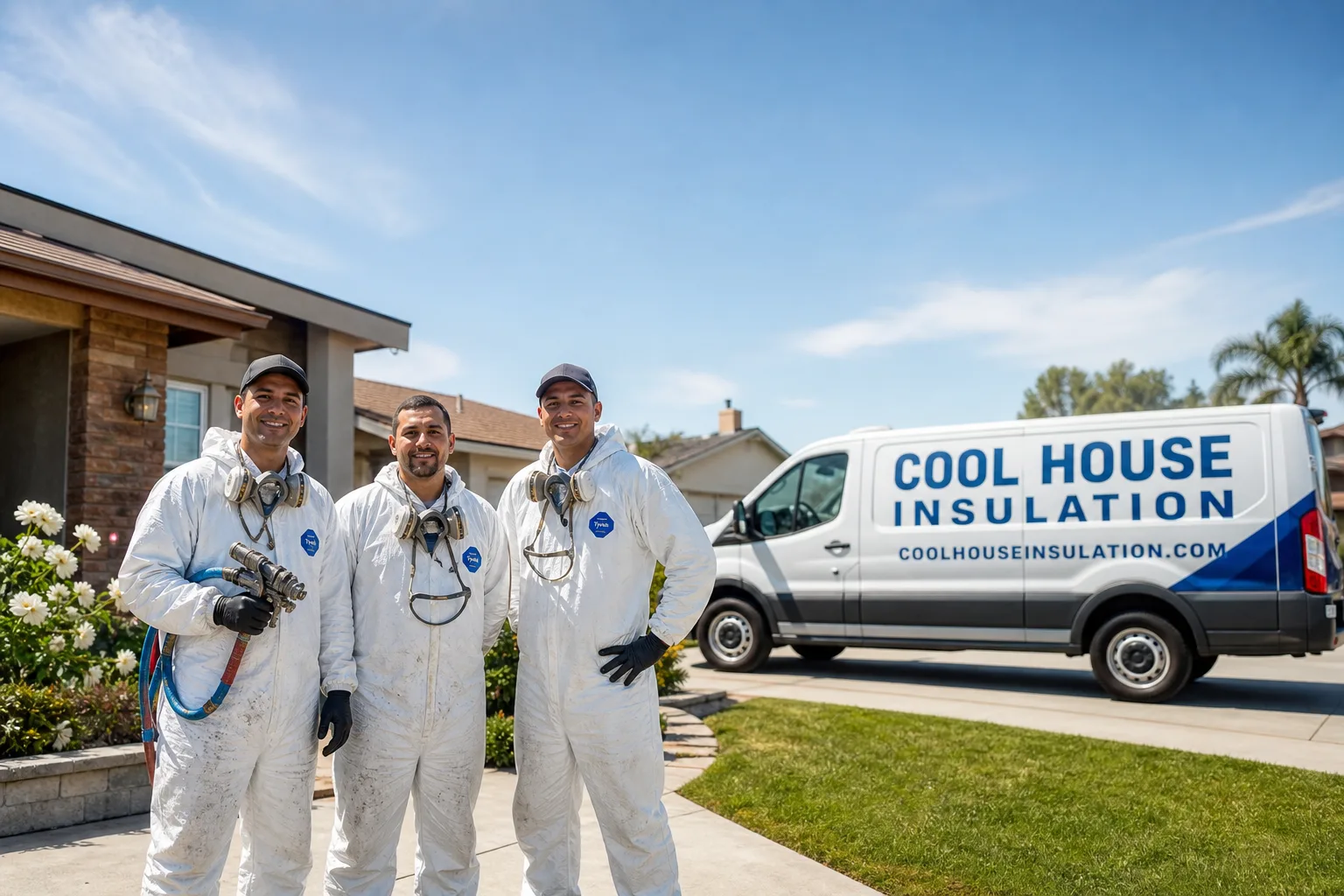
Fast, Reliable Spray Foam Insulation Across Lawndale
Spray foam insulation in Lawndale is rarely a simple attic top-off. Most homes here were built in the 1950s and 60s with empty 2×4 wall cavities, so the real work is full cavity-fill in stucco walls that have never held insulation. That’s the job we do most often in Lawndale, and we’ve done it hundreds of times from Artesia Boulevard to the neighborhoods off Inglewood Avenue. When you call (855) 341-7810, you’re talking to a crew that knows exactly what’s inside your walls before we drill the first hole. We serve all of Lawndale’s 90260 and 90261 zip codes, usually within a day or two of your call.
Why Cool House Insulation Is Lawndale’s Preferred Spray Foam Insulation Company
Lawndale homeowners call us because we don’t push one brand or one method. Our Spray Foam Insulation team carries both Icynene and Demilec open- and closed-cell products, and we recommend the material that fits your wall assembly, not the one we happen to stock. Noel Carrasco, our owner, has walked through enough Lawndale attics to know that a 1958 stucco box on a tight lot needs a different approach than a newer build in Torrance. We’re also authorized installers for Rockwool and CertainTeed, which matters when a customer needs fire resistance or acoustic separation in a duplex or apartment conversion. Reviews from Lawndale customers consistently mention two things: we show up when we say we will, and we explain the scope clearly before any work starts. Our response time to most Lawndale jobs is same-week, and we keep crews staged within a short drive of the 90260 and 90261 zones.
Spray Foam Wall Insulation in Lawndale
Spray Foam Wall Insulation in Lawndale typically means drill-and-fill work on existing stucco, not new-construction open-wall spraying. The process involves drilling small access holes through the exterior stucco or interior drywall, injecting foam into the empty 2×4 stud bays, and patching clean. It’s the standard retrofit for homes built between 1948 and 1965, when wall insulation was omitted entirely in most South Bay tract developments. A typical single-story Lawndale home with four exterior walls runs $3,200 to $6,800 depending on square footage, access, and whether we’re filling all walls or just the west- and south-facing exposures that catch direct afternoon sun.
When cavity-fill beats attic work
Lawndale’s heat problem is mostly radiant, not conductive. The marine layer keeps mornings damp, but by 2 p.m. the sun has been baking west-facing stucco for hours. If your living room faces the afternoon sun and your attic already has some insulation, adding more up top won’t fix the wall heat. We run a simple test: check interior wall temperature at 3 p.m. against the thermostat setting. A 10°F or greater gap means the walls are the problem, not the ceiling.
What the job looks like day-of
We typically complete a drill-and-fill wall insulation job in Lawndale in one day. Holes are small, about the size of a quarter, and we patch them to match. The foam expands to seal the cavity completely, including corners and rim areas where fiberglass batts always leave gaps. For older stucco with hairline cracks, we inspect for moisture issues before spraying, because open-cell foam over damp stucco creates exactly the trapped-moisture problem you don’t want.
Rim Joist Spray Foam in Lawndale
Rim Joist Spray Foam in Lawndale addresses the band joist area where your floor framing meets the foundation wall. In a 1950s Lawndale house, this zone is almost always uninsulated and often the source of condensation you see on interior walls near the baseboards. The marine-layer humidity that sits over the South Bay each morning pushes damp air into that rim joist cavity, and when it hits the cooler concrete or stucco, it condenses. Spraying closed-cell foam here air-seals and insulates in one pass. Typical cost for a Lawndale home’s accessible rim joists runs $1,400 to $2,900 depending on crawl space access and linear footage.
Condensation control
Rim joist foam is one of the highest-value fixes we perform in Lawndale, and it’s often overlooked. It stops the moisture cycle at the source rather than treating the symptom. If you’ve noticed peeling paint, musty smells near baseboards, or cold floors over a crawl space, the rim joist is likely the path. We spray from the crawl space or basement side, never from the interior living space, so there’s no drywall damage or dust inside the house.
Pairing rim joist with wall work
When we’re already drilling and filling walls on a Lawndale home, adding rim joist spray foam is a natural complement. The two jobs share setup time and access planning, so combining them often reduces total project cost by 10-15% compared to doing them separately. It’s the difference between sealing the box and just lining the sides.
Trusted Brands We Service in Lawndale
We install and service spray foam from Icynene and Demilec, the two brands we trust most for Lawndale’s specific conditions, and we also handle Reflectix repair in Lawndale when that’s the right solution for a project. Icynene’s open-cell product works exceptionally well for interior cavity fill in older stucco homes because it allows moisture to move through the assembly without trapping it. Demilec’s closed-cell line is the better choice for rim joists and areas where you need both air sealing and higher R-value per inch. We keep both product lines staged for Lawndale jobs, so turnaround is fast and you’re never waiting on a shipment. For customers who need thermal plus acoustic performance in multi-unit buildings, we also work with Rockwool and CertainTeed products.
Common Spray Foam Insulation Problems We See in Lawndale Homes
- Moisture trapped behind stucco. Lawndale’s marine layer means exterior walls stay damp in the morning. Foam applied over damp stucco or without addressing drainage issues traps that moisture, and within a year or two you’ll see interior mold or peeling paint.
- Overheating in narrow 1950s attics. The tight attic spaces common to Lawndale tract homes need proper venting before any rim joist or roof deck spraying. Foam in a sealed, hot attic degrades faster and can lead to premature failure.
- Missing thermal barrier on closed-cell wall foam. Code requires a thermal barrier between closed-cell foam and living space. Some handyman installs skip this step, which not only fails inspection but traps radiant heat from sun-baked west-facing stucco inside the wall cavity.
- Foam over old knob-and-tube or compromised wiring. Some 1950s Lawndale homes still have original wiring. Foam sprayed over deteriorating insulation jackets can create a fire risk. We inspect and flag this before any job, never after.
Pricing for Spray Foam Insulation in Lawndale, CA
Most Lawndale spray foam projects fall between $1,400 and $6,800 depending on scope. Here’s the honest breakdown: rim joist spray foam runs $1,400 to $2,900, full wall cavity-fill on a single-story stucco home runs $3,200 to $6,800, and a combined rim joist plus two-wall job typically lands between $4,000 and $7,500. Factors that move the number: crawl space access, stucco condition, whether we’re drilling from exterior or interior, and linear feet of rim joist. We give free estimates, and we’ll always show you the square footage math rather than handing over a lump sum. Call (855) 341-7810 and we’ll schedule a walkthrough for your Lawndale home.
We Also Serve Cities Near Lawndale
Our crews work throughout the South Bay, so if you’re in Lawndale or nearby, we’re close by. That includes Hawthorne, Del Aire, Alondra Park, and Inglewood. Same-week scheduling applies across the entire area, and we’re familiar with the housing stock in each of these communities.
Serving Lawndale, CA — Our Local Coverage Area
We’re based in the Lawndale area and know this community well. Use the map below to see our service coverage — if you’re nearby, we can almost certainly help.
FAQs About Spray Foam Insulation in Lawndale
Yes. We use drill-and-fill injection, which means small access holes through the stucco or drywall, foam injection into the empty stud bays, and clean patching. No interior demolition. Most single-story Lawndale homes are done in one day. Call (855) 341-7810 for a free assessment of your specific walls.
Yes, in most cases it’s the primary fix. That condensation comes from humid marine-layer air hitting cool surfaces where the rim joist meets the foundation. Closed-cell foam seals the air path and insulates the surface, stopping the moisture cycle. We see this exact issue in homes off Artesia and Hawthorne Boulevards regularly. Call us at (855) 341-7810 and we’ll confirm the source in person.
Open-cell Icynene spray foam is usually the right call for the walls in this scenario. It insulates well, allows moisture movement, and expands fully into irregular 2×4 cavities without over-pressuring old stucco. For rim joists in the same building, we’d switch to Demilec closed-cell for the air seal. The narrow attic means venting must be addressed first. Estimates are free, call (855) 341-7810.
For wall cavities, spray foam outperforms blown-in because it air-seals while it insulates. Blown-in fiberglass or cellulose can settle and won’t stop air movement through the stud bays, which is the bigger problem in Lawndale’s damp, drafty stucco homes. Our Spray Foam Insulation approach fills and seals the entire cavity. For attics, blown-in remains a strong option, but for walls, foam wins. Call (855) 341-7810 and we’ll walk you through the tradeoffs for your specific layout.
Not necessarily. Spray foam in the wall cavity addresses conductive and convective heat gain, which is most of the problem. A radiant barrier in the attic addresses a different vector: radiant heat hitting the roof plane. In Lawndale’s specific climate, the bigger win is usually the wall foam. We’ll tell you if your roof assembly actually needs more. Call (855) 341-7810 and we’ll check both.
We were called to a 1958 stucco tract home off Artesia Boulevard where the west-facing living room hit 85°F by 3 p.m. even with the windows open. Our crew drilled and filled the 2×4 wall cavities with Icynene spray foam, sealing the stud bays that had been empty since the aerospace-era build. The homeowner reported the room staying 10°F cooler the following week, and we noted no condensation on the interior stucco afterward. That’s the standard Lawndale job for us: not an upgrade, but a from-scratch install in a house that never had wall insulation at all.
Written by Noel Carrasco, Owner at Cool House Insulation, serving Lawndale and the South Bay.