
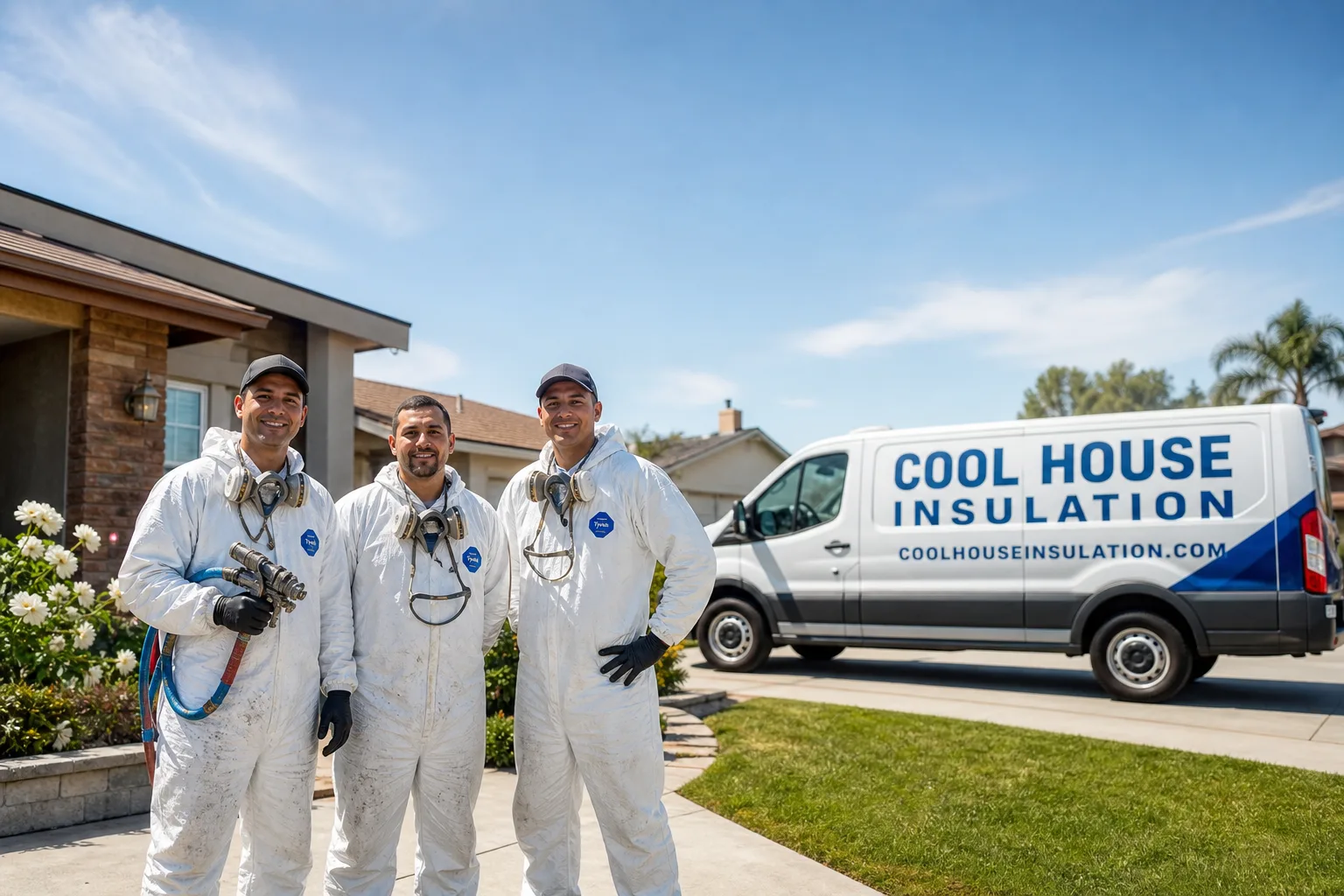
Fast, Reliable Spray Foam Insulation Across El Monte
Spray foam insulation in El Monte typically runs $2,800 – $6,400 for an attic retrofit on a 1940s – 1960s tract home, depending on whether you go open cell or closed cell and how much of the roofline and rim joist we treat. We get most El Monte jobs scheduled within a week, and a full attic spray usually wraps in one to two days. If your summer cooling bills are climbing and rooms on the west side of the house feel like ovens by 4 p.m., the walls and attic are usually the culprit. Call (855) 341-7810 for a free estimate from a crew that knows the 91731 and 91732 tracts block by block.
Why Cool House Insulation Is El Monte’s Preferred Spray Foam Insulation Company
We’re not based in El Monte, but we work these streets every week. The single-story stucco bungalows and 1950s tract homes here have their own set of problems, and our crews have spent enough time crawling through low-pitch attics to know exactly what they’ll find before the ladder even goes up. Noel Carrasco, who leads our team, started this company with one rule: carry the right material for the house, not the other way around. That’s why we install products from eight different manufacturers, including Icynene and Demilec for spray foam, instead of pushing whatever brand we happen to have a contract with.
Homeowners across El Monte call us for the same reasons: the attic heat is unbearable, the cooling bill climbed again, or a remodel exposed walls with literally nothing in them. We also get calls from local remodeling contractors who need a multi-material insulation sub for additions and flips in 91731 and 91732. What sets us apart is the diagnosis first. We open the attic or wall cavity, look at what’s actually there, and then recommend open cell, closed cell, or a hybrid based on how that specific structure performs. Sometimes spray foam isn’t even the right answer, and we’ll tell you that flat out. That’s what keeps people calling.
Closed Cell Spray Foam Insulation in El Monte
Closed Cell Spray Foam Insulation is the denser, more structural option we install across El Monte when homeowners need maximum R-value per inch and a vapor barrier in the same pass. In a 1950s stucco bungalow with uninsulated wall cavities, closed cell at 2 – 3 inches delivers roughly R-7 per inch while also stiffening the wall assembly and sealing the gaps that let attic heat radiate into living space. A full closed cell attic roof deck retrofit on an El Monte home runs $4,200 – $6,400, with rim joist and knee wall work adding to that depending on the footprint.
When El Monte homes benefit most from closed cell
Closed cell earns its cost here in two situations. First, when the roof deck is the only viable insulating plane, meaning the attic is too tight to vent properly or you’re finishing the attic into living space. Second, when the wall cavities are accessible during a gut remodel and you want thermal and moisture control in one shot. In El Monte’s mild winters, the heating-side payoff matters less than the cooling-side and structural benefit. If you’re spending on closed cell, it should be because the house demands it, not because it’s the default. We’ll show you the difference before any product gets sprayed.
What you get for the closed cell price
Closed cell installs in El Monte have a specific job to do beyond insulation itself. The foam seals every crack at the wall plate, rim joist, and rafter bay, which matters in these older tracts where original framing has pulled apart over 60-plus years of summer expansion. We’ve measured thermal bridging through 2×4 rafters that cuts the effective R-value of any insulation, and closed cell at least wraps those surfaces densely enough to minimize the loss. The material also adds racking strength to aging walls and rooflines, which matters when El Monte homes sit in an area that’s seen its share of seismic activity.
Open Cell Spray Foam in El Monte
Open Cell Spray Foam is the smart default for most El Monte attic retrofits, especially in the 91731 and 91732 tracts where knee-height eaves and original 2×4 rafters make airflow management the real craft. It runs $2,800 – $4,600 for a typical roofline application on a 1,200 – 1,600 square foot single-story home. Open cell expands aggressively, fills odd-shaped cavities including tight rafter bays and around wiring, and leaves an air barrier that’s far more forgiving than batt on a low-pitch roof. It doesn’t act as a vapor barrier, which is usually fine here because El Monte’s problem is heat, not humidity.
Why open cell fits older El Monte attics
Those low-pitch attics in 91732 with only knee-height clearance at the eaves are exactly where open cell shines. The foam fills the rafter bay completely, including the wedge-shaped spaces near the soffit that batt never touches. But here’s the part generic spray foam installers miss: if you spray foam tight against the eaves without first installing ventilation chutes or baffles, you block soffit airflow entirely. That traps the 140°F+ summer heat and whatever moisture builds up in the attic instead of venting it. Our crews cut and seat baffles at every soffit bay before spraying. It’s slower, it’s meticulous, and it’s the difference between a foam job that works and one that cooks the roof deck.
Combining open cell with radiant control
Open cell alone won’t stop radiant heat gain through the roof deck. It slows conductive heat transfer, but the sun beating on an El Monte composition shingle roof transfers radiant heat downward. That’s why we often pair open cell on the roofline with a radiant barrier on the underside of the roof deck or rafter faces. The two mechanisms together handle both the conductive and radiant loads that push attic temperatures past 140°F in August. It’s an approach we recommend only when the house actually needs it, which in this part of the San Gabriel Valley is most of them.
Trusted Brands We Service in El Monte
We’re not tied to a single spray foam manufacturer, which means your El Monte home gets the product that fits the job rather than the product we happen to stock. Our crews are authorized to install Icynene open cell and Demilec closed cell, two of the most established names in spray foam performance. Each has different expansion, density, and application characteristics, and we choose between them based on your attic geometry, wall assembly, and budget. We also work with Spray Foam Insulation products from CertainTeed and Rockwool when a job calls for hybrid material work, like mineral wool soundproofing in a shared-wall El Monte duplex. Quick turnaround on product for local jobs means we’re not delayed waiting on manufacturer shipments from out of state.
Common Spray Foam Insulation Problems We See in El Monte Homes
- Foam against knee-height eaves with no baffles: The 91731 and 91732 tracts have eaves that are often only knee-height at the outside edge. Spray foam applied tight against them seals the soffit vents shut, which traps heat and moisture in the low-pitch attic instead of letting it escape.
- Thermal bridging through original 2×4 rafters: Even with foam in the rafter bays, the wood framing itself transmits heat. In El Monte’s inland summer, that bridging shows up as hot stripes across the ceiling, especially in rooms facing west.
- Closed cell sprayed everywhere as a default: A mild-winter El Monte home has a cooling-dominated load. Closed cell everywhere overspends on heating-side performance. Open cell plus radiant control usually delivers the same comfort for less money.
- Knob-and-tube-era framing gaps left unsealed: Original framing from the 1940s and 1950s has pulled apart over decades of summer expansion. If those gaps at the wall plate and rim joist aren’t sealed with foam, the insulation loses effectiveness through air movement.
Pricing for Spray Foam Insulation in El Monte, CA
For a typical 1,200 – 1,500 square foot El Monte single-story home, here’s what we quote:
| Application | Typical Range |
|---|---|
| Open cell attic roofline (with baffles) | $2,800 – $4,600 |
| Closed cell attic roofline | $4,200 – $6,400 |
| Rim joist and wall plate sealing | $900 – $2,200 |
| Garage ceiling spray foam | $1,400 – $2,800 |
| Hybrid open cell + radiant barrier | $3,200 – $5,400 |
What moves the number is square footage, eave and soffit complexity, and whether the attic is a finished or unfinished plane. Older El Monte tract homes with original soffit wood and tight clearances add labor hours for the baffle work, but that’s not where you want a crew cutting corners. We give free on-site estimates with a written line item breakdown, so you know what you’re paying for before anything gets sprayed. Call (855) 341-7810 to schedule yours.
We Also Serve Cities Near El Monte
If you’re in a neighboring SGV city, we cover South El Monte, North El Monte, Temple City, and Rosemead as well. The housing stock and attic profiles are similar, so the same craft applies. If you’re in any of these nearby communities, call us and we’ll set an estimate like we would for any Spray Foam Insulation in El Monte job, no different.
Serving El Monte, CA — Our Local Coverage Area
We’re based in the El Monte area and know this community well. Use the map below to see our service coverage — if you’re nearby, we can almost certainly help.
FAQs About Spray Foam Insulation in El Monte
Because the original eaves in these mid-century tracts are only knee-height at the outside edge, and the rafters are 2×4 with no baffles installed at the soffit. If foam goes in without creating a ventilation channel first, airflow through the soffit vents gets sealed off. That traps the heat that builds past 140°F in summer, along with any moisture, inside the low-pitch attic. Our crews seat a baffle at every soffit bay before spraying, which keeps the roof deck vented while the foam does its job below. Call (855) 341-7810 and we’ll check whether your attic has that constraint.
For most 1950s stucco bungalows in El Monte, open cell on the roofline with radiant control costs less and handles the cooling-dominated load. Closed cell only makes sense when you need a vapor barrier, when the attic is being finished into living space, or when the walls are gutted and you want structural stiffening as part of the same pass. We’ll open the attic, look at the framing and venting, and tell you which one actually fits your house rather than defaulting to the pricier option.
Spray foam can cover the framing itself, but the real issue with knob-and-tube-era homes in El Monte is the gaps those original frames develop after 60-plus years of summer expansion. The wood pulls apart at the wall plate, rim joist, and rafter connections, leaving air channels that let heat into the living space regardless of what insulation sits in the cavity. Foam is actually the best product for sealing those gaps because it expands into them. But you have to address the air sealing as part of the insulation job, not as an afterthought. We inspect for those gaps before quoting, and we bring them into the price so you’re not surprised mid-job.
Yes, and we do it regularly in the 91731 and 91732 tracts where that’s the dominant attic shape. The knee-height clearance isn’t a reason to skip it, but it does change the application. The foam has to be sprayed from the attic floor or from scaffolding, and the eave area has to be handled sequentially, baffle by baffle, so the soffit vents stay clear. It’s slower work than spraying a tall attic, which is why some contractors avoid it. We’re used to it, and we factor the labor into the quote so there’s no surprise upcharge at the end.
It depends on where the heat is coming from, but in most El Monte tract homes the back bedrooms overheat because the west-facing roof deck bakes all afternoon and the attic above those rooms has thin or no insulation. Spray foam on that roofline makes the biggest single difference. But if the wall cavities are uninsulated and the original framing gaps aren’t sealed, foam alone may not get the room where you want it. We’ve seen 91732 homes where the back bedrooms held 10 – 12 degrees cooler after a roofline spray plus gap sealing at the wall plates. Call (855) 341-7810 and we’ll look at your specific room layout and attic before making the recommendation.
Written by Noel Carrasco, Owner at Cool House Insulation, serving El Monte and the San Gabriel Valley since day one.