
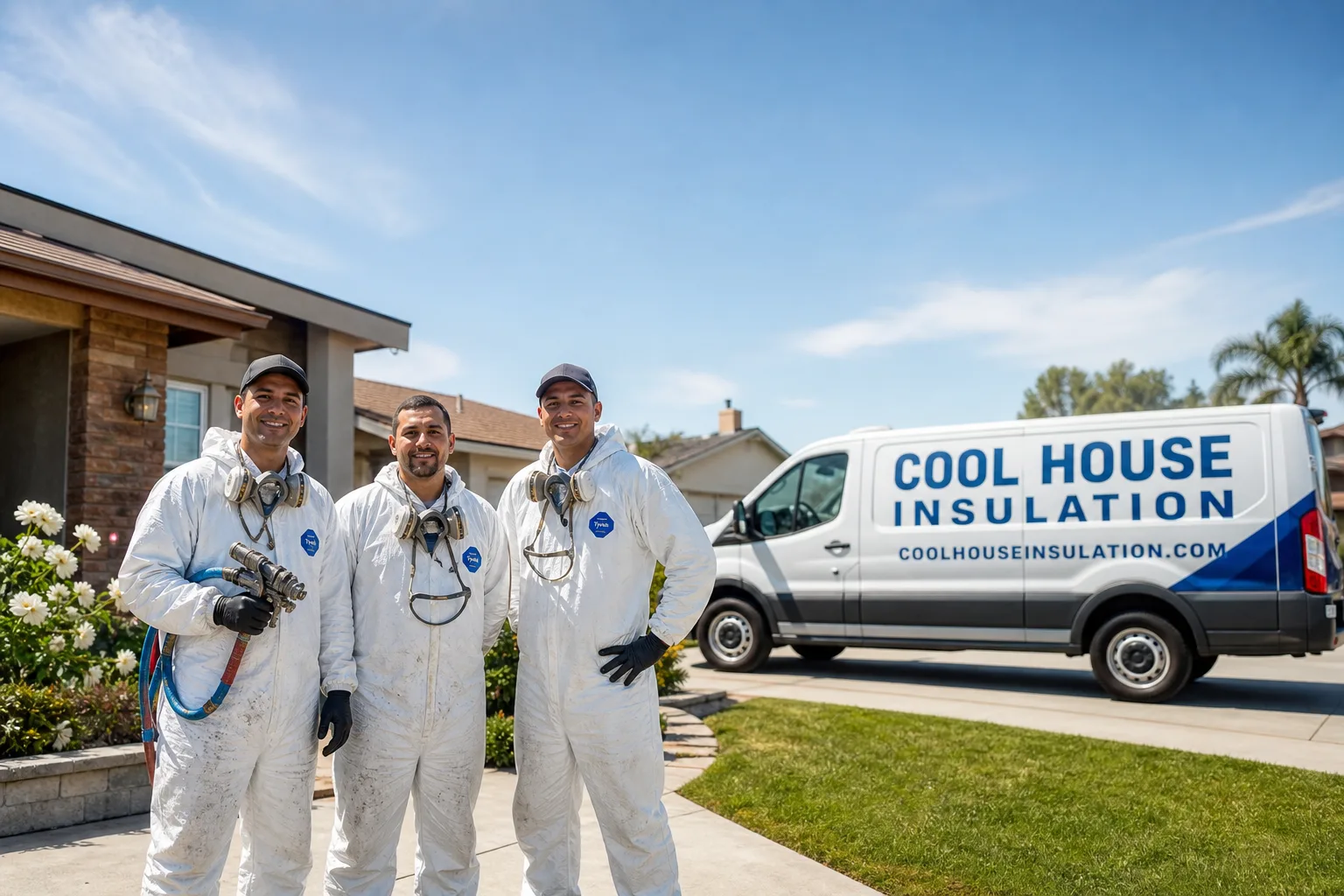
Fast, Reliable Spray Foam Insulation Across Newport Beach
Spray foam insulation in Newport Beach works differently than it does inland, and understanding that difference saves you from paying for a retrofit that fails. Closed-cell foam usually runs $2.50 – $4.50 per board foot installed here, while open-cell lands between $1.20 – $2.00 per board foot. On the Peninsula, Balboa Island, and the harbor-view hills, the marine layer means moisture control matters as much as R-value. We serve every Newport Beach ZIP code, including 92662, 92663, 92658, and 92659, and we can usually be on-site within 24 – 48 hours for an estimate. Call (855) 341-7810 and we’ll talk through what your walls actually need.
Why Cool House Insulation Is Newport Beach’s Preferred Spray Foam Insulation Company
We’ve worked in enough Newport Beach attics and crawlspaces to know that a Balboa Island cottage from 1940 and a Dover Shores ranch from 1968 need completely different foam strategies. That local familiarity is why homeowners here call us instead of an out-of-town crew that treats every wall the same. Noel Carrasco leads our team, and he’s spent years diagnosing coastal insulation failures specific to this stretch of Orange County. We carry both Icynene and Demilec spray foam systems, which means we’re not pushing one product because it’s the only one we stock.
Newport Beach customers tell us the same thing repeatedly: the estimate was straightforward, the crew showed up when they said they would, and the foam stopped the condensation they’d been fighting for years. We’re authorized to install products from eight manufacturers including Owens Corning, CertainTeed, and Rockwool, but we recommend the material that fits the assembly, not the one that’s easiest for us. That’s the difference between a contractor who sprays foam and a company that understands Spray Foam Insulation as part of a coastal building science problem.
Crawl Space Spray Foam Insulation in Newport Beach
Crawl Space Spray Foam Insulation on a Newport Beach hillside lot means sealing a damp, salt-exposed cavity that’s fighting the Pacific Ocean every single night. Homes above Newport Harbor, especially the 1950s – 70s ranch houses off Irvine Avenue and in the 92660 hills, sit on crawlspaces where marine-layer fog moves in after sunset and never fully burns off. We spray closed-cell foam directly onto the rim joists and subfloor, creating a thermal and vapor break that batts simply can’t achieve in that environment. A typical crawl space here runs $2,800 – $5,500 depending on square footage and access.
Rim Joist Sealing on Steep Lots
The rim joist is where your floor framing meets the foundation, and on a steep Newport Beach lot it’s also where fog-driven moisture enters first. We see rusted rim-joist insulation staples on nearly every coastal home we open up. Closed-cell foam bonds to the rim and stops air movement cold.
Vapor Control Under Harbor-Facing Homes
When your crawlspace sits inches above the water table or faces Newport Harbor, the concern isn’t just heat loss. It’s moisture wicking up through the structure and condensing on cool surfaces. Closed-cell foam handles both problems in one application because it’s an air barrier, vapor retarder, and insulator simultaneously.
Garage Spray Foam Insulation in Newport Beach
Garage Spray Foam Insulation in Newport Beach usually targets a garage someone wants to use for more than parking, whether that’s a bonus room, a workshop, or a home gym on a lot where every square foot counts. Many Newport Beach garages sit under living space or attach directly to the house, and an uninsulated garage ceiling pulls conditioned air out of the rooms above it. We spray closed-cell foam onto the ceiling and shared walls, which also quiets the garage door and any harbor noise. Expect $1,800 – $3,600 for a standard two-car garage.
Garage Ceiling Foam for Bonus Rooms
If your garage ceiling has living space above it, open-cell foam in the joist bays cuts heat transfer dramatically. The foam expands into every corner of the cavity, so no air moves between the garage and the room above. This matters in Newport Beach where garages often sit under bedrooms on tight lots.
Shared Wall Treatment
The wall between your garage and your living room leaks conditioned air constantly. Spraying closed-cell foam on that shared wall not only insulates but also blocks exhaust fumes and noise from migrating into the house. It’s the single most overlooked surface in Newport Beach garages.
Trusted Brands We Service in Newport Beach
We’re factory-authorized to install Icynene and Demilec spray foam, two names that matter in coastal applications where open-cell breathability or closed-cell vapor control makes the difference. For jobs that call for blown-in or batt instead, we carry GreenFiber and CertainTeed products, so you’re never forced into a foam solution when the assembly doesn’t want one. We keep stock moving through our La Palma shop so Newport Beach projects don’t stall waiting on material. The right foam for your walls, not the only foam we sell.
Common Spray Foam Insulation Problems We See in Newport Beach Homes
- Single-wall stucco-and-lath cottages with no cavity. On the Peninsula and Balboa Island, homes built before the 1960s often have plaster directly over wood framing with no stud bay to fill. Spray foam can’t bond properly here without a rigid or injected retrofit first, and foam applied anyway de-laminates.
- Salt-laden fog eating through vapor barriers under cantilevers. Harbor-facing bay windows and decks trap salt air against staple-attached kraft facings. Within a few seasons, those staples rust through and the facing sags, letting foam pull away from the substrate and leaving hidden voids.
- Marine-layer condensation in under-vented attics. The 1950s – 70s ranch homes above Newport Harbor often have minimal attic ventilation. When foam is installed without addressing airflow, trapped moisture condenses on the cool side of the foam and sits against the roof deck.
- Mixed retrofits on raised beach cottages. Homes raised or rebuilt after the 1930s – 50s frequently have insulation missing entirely under bay windows and cantilevered decks facing the harbor. Those voids go unnoticed until a remodel opens the wall or a homeowner asks why one room never holds temperature.
Pricing for Spray Foam Insulation in Newport Beach, CA
Closed-cell spray foam in Newport Beach runs $2.50 – $4.50 per board foot installed, and open-cell runs $1.20 – $2.00 per board foot. A crawl space typically totals $2,800 – $5,500, a two-car garage $1,800 – $3,600, and a full wall retrofit on a beach cottage can span $8,000 – $20,000 depending on whether we’re injecting behind existing plaster or opening cavities. Newport Beach pricing runs slightly above inland Orange County because of access, older framing, and the vapor-control detailing this coast demands. We’ll give you a line-item estimate before any work starts. Call (855) 341-7810 and we’ll walk the space with you.
We Also Serve Cities Near Newport Beach
Our crews work throughout the Newport Beach area, including Costa Mesa, San Joaquin Hills, Fountain Valley, and Irvine. If you’re just outside the city limits, we can still get to your project. Read more about our full coverage area on the Spray Foam Insulation in Newport Beach page. We know these streets, and we’ll give you the same straight answer we’d give a neighbor here.
Serving Newport Beach, CA — Our Local Coverage Area
We’re based in the Newport Beach area and know this community well. Use the map below to see our service coverage — if you’re nearby, we can almost certainly help.
FAQs About Spray Foam Insulation in Newport Beach
Yes, but not by spraying into empty stud bays, because those cottages don’t have stud bays. We use closed-cell foam as an injected or rigid retrofit behind existing plaster, which seals and insulates the wall without gutting your interior. On Balboa Island and the Peninsula this is standard work for us. Call (855) 341-7810 and we’ll assess your wall assembly before recommending anything.
Because the marine layer keeps single-wall stucco-and-lath assemblies damp most of the year, so the foam’s vapor-control function prevents condensation, mold, and salt-driven corrosion that fiberglass can’t stop. R-value is secondary when the real enemy is fog-driven moisture sitting inside your walls. Closed-cell foam’s vapor retarder property is what protects a Peninsula cottage, not its insulating numbers.
Salt-laden fog drives rust-through on the staples and vapor-barrier facings that hold batt insulation in place, and within a few seasons the insulation fails and sags. We remove the failing material, treat the framing, and install closed-cell foam that bonds directly to the substrate and vapor-seals the cavity. On Balboa Island we’ve opened cantilevered bays on raised 1940s cottages and found the cavity completely empty except for rusted staples and shredded kraft facing.
Often yes, because those homes have minimal attic ventilation and marine-layer moisture gets trapped against the foam instead of escaping. We evaluate the attic’s airflow path before spraying, and in many cases we recommend adding or correcting venting first. The foam only works fully when the attic can dry itself out.
Yes, we work steep lots throughout the 92660 and 92658 hills regularly. Crawl spaces on those slopes are where fog moves in at night and never fully clears, so closed-cell foam on the rim joists and subfloor is usually the right call. We’ll give you a free estimate with real numbers for your specific lot. Call (855) 341-7810.
Written by Noel Carrasco, Owner at Cool House Insulation, serving Newport Beach and coastal Orange County.