
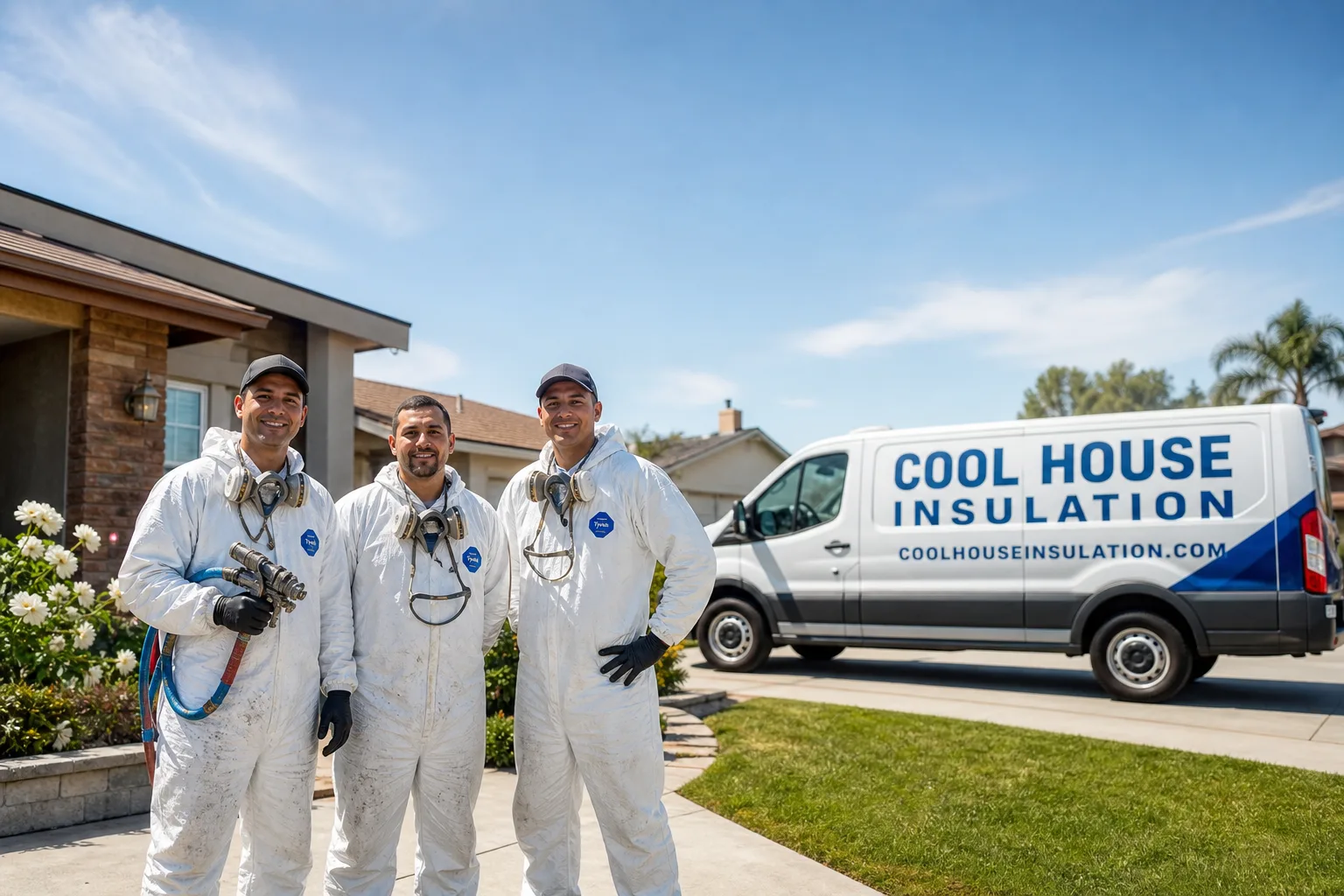
Fast, Reliable Spray Foam Insulation Across La Habra Heights
Spray foam insulation in La Habra Heights typically costs $2.50 to $6.75 per board foot installed, with most attic projects landing between $4,800 and $14,000 depending on square footage and access difficulty. That’s what we charge in this city, and it reflects the reality of working on hillside custom homes with vaulted ceilings and low-pitch tile roofs rather than flatland tract houses. Our crew knows West Road from Hacienda Boulevard, and we understand that every La Habra Heights job is different because every house up here was built differently. The job gets done right, with the foam spec matched to your specific roof geometry and fire-zone requirements. Call (855) 341-7810 for a free estimate, and we’ll send Noel Carrasco or one of his lead techs to walk your attic and give you a straight number.
Why Cool House Insulation Is La Habra Heights’s Preferred Spray Foam Insulation Company
We’re not a single-brand shop pushing one foam product on every house. We carry open-cell and closed-cell systems from Icynene and Demilec, plus Rockwool mineral wool and CertainTeed fiberglass for hybrid applications where foam alone isn’t the answer. That means when we walk an attic in La Habra Heights, the recommendation you get is the one that actually fits your rafter depth, your roof pitch, and your Chapter 7A fire-zone requirements. Not the one that’s easiest for us to sell.
Homeowners across La Habra Heights have called us back for second projects because we work clean, we’re careful around exposed beams and finished drywall, and we don’t leave foam overspray on your tile roof. Response time matters too. We’re based in La Palma, so a crew can be at a property off Hacienda or up Skyline Drive within an hour on most days. When a hillside homeowner spots ember-vent failure or a sagged batt cavity, they don’t want to wait a week. We get there fast.
Noel Carrasco has built the company around one idea: the right insulation for your home, not the only one we carry. That plays out in every attic we spray in La Habra Heights. If closed-cell Demilec off-gassing isn’t right for your tight cathedral cavity, we’ll say so and spec open-cell Icynene or a Rockwool hybrid. Most insulators can’t have that conversation because they’re locked into one product line. We’re not.
Spray Foam Attic Insulation in La Habra Heights
Spray foam attic insulation in La Habra Heights is the fix we recommend most often for vaulted, exposed-rafter ceilings where legacy fiberglass batts have sagged and left hot pockets against the roof deck. In this city, that’s nearly every 1950s-to-1990s custom home. The job involves decking out the rafter bays, checking the air barrier at every ceiling penetration, and spraying open-cell foam (usually Icynene) tight against the underside of the roof sheathing. On a 1,800-square-foot vaulted attic, expect $6,000 to $11,000. On a smaller low-pitch attic space where we’re working on kneepads through a narrow tile-roof access hatch, it can run lower, but the labor intensity keeps the per-board-foot cost higher than a flatland truss attic.
La Habra Heights attics aren’t walkable the way Fullerton attics are. The low-pitch concrete tile roofs leave 18 to 30 inches of headroom in the best spots, and often much less at the eaves. We’ve done whole roof decks from our knees. That is not an exaggeration. The work is slower, it’s sweatier, and the access hatches are often cut into the gable end behind a bougainvillea hedge. Our techs know to look for the hatch on the uphill side of the hillside houses, which sounds obvious until you’ve spent twenty minutes with a ladder on the wrong side of a sloped property.
Vaulted Ceiling Rafter Bays
Vaulted ceilings are the signature feature of La Habra Heights custom homes, and they are also the signature insulation failure. The original fiberglass batts, installed forty or fifty years ago against exposed rafter bays, were never intended to hold their shape under a tile roof that hits 140 degrees in July. They sag, they split, and the air gap between the batt and the roof deck becomes a convection highway. We remove what’s left, air-seal the rafter cavities, and spray open-cell foam directly against the sheathing. The vaulted room below stops cooking.
Low-Pitch Tile Roof Access
Low-pitch tile roof access is the part of this work that separates experienced hillside crews from everyone else. The tile roof means no straightforward walk-in attic. You’re entering through a 22-by-30-inch hatch, often at the gable, and the pitch means there’s no standing room. If a homeowner asks whether we can actually spray a tight attic under a low-pitch roof, the answer is yes, but only with patience and the right equipment. We use shorter foam guns, maintain lower spray pressure on the ceiling deck, and schedule the work in the morning before the roof heats the attic past what’s safe for a crew to work in.
Spray Foam Wall Insulation in La Habra Heights
Spray foam wall insulation in La Habra Heights is most common on two types of projects: full remodels where walls are open to the studs, and older custom homes where the original wall cavities were never insulated to begin with. The latter is more common than you’d think. Plenty of 1960s hillside homes were framed with the assumption that a fire-resistant concrete tile roof and stucco exterior would handle temperature, so the wall cavities got nothing. The result is a house that soaks up afternoon heat through the west-facing walls and never fully cools at night. Open-cell Icynene spray foam in the stud bays changes that immediately. For a typical 2,500-square-foot La Habra Heights remodel with walls open, expect $3,800 to $7,200 for wall cavity spraying depending on stud depth and window count.
Retrofitting closed walls is different. It requires drilling and injection, and most La Habra Heights homeowners choose open-cell foam for this because it expands gently and won’t bow drywall the way closed-cell can. Santa Ana season matters here too. Wind-driven air pressure on the hilltop pushes conditioned air through every rat-slab penetration and electrical outlet on the windward side. Spray foam wall insulation done right closes those pathways, but the air-barrier detail matters more on a wind-exposed hillside than it does in the flats below.
Closed-Cell for Fire-Zone Walls
Closed-cell foam has a role in La Habra Heights wall cavities, specifically on homes that sit in the most fire-exposed wildland-urban interface zones. Demilec closed-cell adds structural strength and a vapor barrier, and it doesn’t wick water the way open-cell can. For a hillside homeowner hardening a house against ember intrusion, we sometimes spec closed-cell on the lower band of exterior wall plates in combination with open-cell higher up. It costs more per board foot, usually $4.50 to $6.75, but the payback in fire resilience and air-sealing on a steep slope is real.
Rim Joist Sealing
Rim joist spray foam is the quiet workhorse of a La Habra Heights wall insulation job. The rim joist, the band of framing where the floor system meets the foundation wall, is where cold air gets pulled into the house on winter nights up on the hill. We spray closed-cell foam into the rim bays from the crawlspace or basement side, sealing the gap and stopping the draft at the source. It’s a smaller job, usually $1,200 to $2,400 on a typical 1,800-square-foot hillside home, and it makes an outsized difference in floor temperature during the cold snaps that hit harder at La Habra Heights elevation than they do in Fullerton or La Mirada below.
Trusted Brands We Service in La Habra Heights
We carry and install products from a roster of eight manufacturers, but the two that matter for La Habra Heights spray foam are Icynene and Demilec. Icynene open-cell is our default for vaulted rafter decks and wall cavities where expansion and vapor permeability matter. Demilec closed-cell comes in for fire-zone wall plates, rim joists, and roof decks where a vapor barrier and added structural rigidity are part of the spec. We also keep CertainTeed batts and Rockwool mineral wool on hand for hybrid jobs, like a garage ceiling where a homeowner wants spray foam performance on a batt budget cap. We stock the materials our La Habra Heights customers need most, so there’s no second trip down the hill for another kit when your attic is half open.
Common Spray Foam Insulation Problems We See in La Habra Heights Homes
- Sagged legacy fiberglass in vaulted rafter bays: The original 1970s and 1980s batts in these exposed-rafter ceilings lose their friction fit within fifteen to twenty years. They pull away from the roof deck, and the attic becomes a hot-air channel instead of an insulated cavity. We see this on nearly every pre-1990 custom home we walk in La Habra Heights.
- Chapter 7A ember-vent failures: Foam sprayed without checking gable and eave vents for proper screening leaves a hillside home vulnerable during Santa Ana conditions. The insulation can be perfect and the fire assembly still fails. We verify vent screening and roof clearance before we spray, as part of the job, not as an add-on.
- Wind-driven air leaks through cathedral penetrations: The hilltop wind exposure means recessed lights, ceiling fans, and old vent openings in vaulted ceilings leak air at a rate flatland homes never experience. Spray foam closes them, but only if the penetrations are found and prepped first. A rushed job misses them.
- Low-pitch attic access damage: Some homeowners have had insulation contractors refuse to quote because the attic is too tight. Others have had contractors send techs who banged up drywall trying to get up there. We’re used to working on kneepads in 24 inches of headroom. The job is slow, but it’s done without wrecking your ceiling.
Pricing for Spray Foam Insulation in La Habra Heights, CA
Open-cell spray foam in a La Habra Heights attic runs $2.50 to $3.75 per board foot installed. Closed-cell runs $4.50 to $6.75. A 1,500-square-foot vaulted attic sprayed with open-cell typically falls between $4,800 and $7,500. A full wall cavity job on an open-stud remodel lands between $3,800 and $7,200 depending on the framing depth. Rim joist sealing runs $1,200 to $2,400 on most hillside homes. The main cost drivers in this city are access difficulty, the number of vaulted sections, and whether Chapter 7A fire-zone verification adds prep work around vents and roof clearances. Free estimates on all of it. Call (855) 341-7810 and our estimator will give you a breakdown specific to your attic or wall cavities.
We Also Serve Cities Near La Habra Heights
Our crews work throughout the hills and the flats around La Habra Heights, including La Habra, East La Mirada, Fullerton, and La Mirada. If you’re in one of those cities and need Spray Foam Insulation with the same brand-agnostic approach, we’ll bring the same crew and the same attention to fire-zone and roof-access details. Same phone: (855) 341-7810.
Serving La Habra Heights, CA — Our Local Coverage Area
We’re based in the La Habra Heights area and know this community well. Use the map below to see our service coverage — if you’re nearby, we can almost certainly help.
FAQs About Spray Foam Insulation in La Habra Heights
Yes, and it’s the most common spray foam job we do in La Habra Heights. Open-cell foam like Icynene is sprayed directly against the underside of the roof sheathing between the exposed rafters, which air-seals the cavity and stops the afternoon heat gain that plagues vaulted ceilings under low-pitch tile roofs. The existing fiberglass or rock wool gets pulled out first, and we verify every ceiling penetration is sealed before the foam goes in. Cost typically runs $2.50 to $3.75 per board foot. Call (855) 341-7810 for an attic-specific quote.
Yes, in the wildland-urban interface zones that cover much of La Habra Heights, Chapter 7A building codes apply to the roof assembly, vent openings, and clearance details around the insulation installation. The insulation itself isn’t the fire rating, but the assembly as a whole has to meet the standard. We check gable and eave vents for proper ember screening, verify roof clearance at the eave line, and document everything before we spray. Call (855) 341-7810 and we’ll tell you whether your specific hillside property falls in a Chapter 7A zone.
Yes, we do it regularly. The low-pitch concrete tile roofs on many La Habra Heights homes leave 18 to 30 inches of headroom at the ridgeline and much less at the eaves. That means our techs work from kneepads through narrow access hatches, often at the gable end, and we use shorter foam guns to handle the tight spaces. The job takes longer than a walk-in attic, which is reflected in the labor cost, but the attic isn’t too tight for us to spray. Call (855) 341-7810 and our lead tech will assess your access points.
Because La Habra Heights sits on an inland hilltop above the Orange County basin. Higher elevation means stronger afternoon sun exposure and less marine influence than Fullerton or Whittier, so attic cavities climb to 140 degrees or more in summer. Then on winter nights, clear-air inversions drain heat from the hilltop faster than the flatlands below. Santa Ana winds compound it by driving hot, dry air through the eave and gable openings. Spray foam insulation in La Habra Heights has to handle both swings, which is why we spec open-cell for the thermal air barrier and verify vent screening for the wind-driven fire exposure. Call (855) 341-7810 to talk about your attic’s specific exposure.
If your house sits on a hillside lot with vaulted ceilings and the original fiberglass batts, retrofit spray foam is usually the better long-term move. In La Habra Heights, the existing insulation in older custom homes is almost always sagged, split, or missing from sections of the rafter bays, which no patching will fix. Air sealing the rafter cavities with spray foam solves the heat gain problem at its source. For some homes, a hybrid approach using Rockwool batts in certain sections alongside foam in the vaulted areas is the right call. We’ll tell you honestly which one fits your attic. Call (855) 341-7810 for a no-pressure walkthrough.
Written by Noel Carrasco, Owner at Cool House Insulation, serving La Habra Heights since day one of the hillside work.