
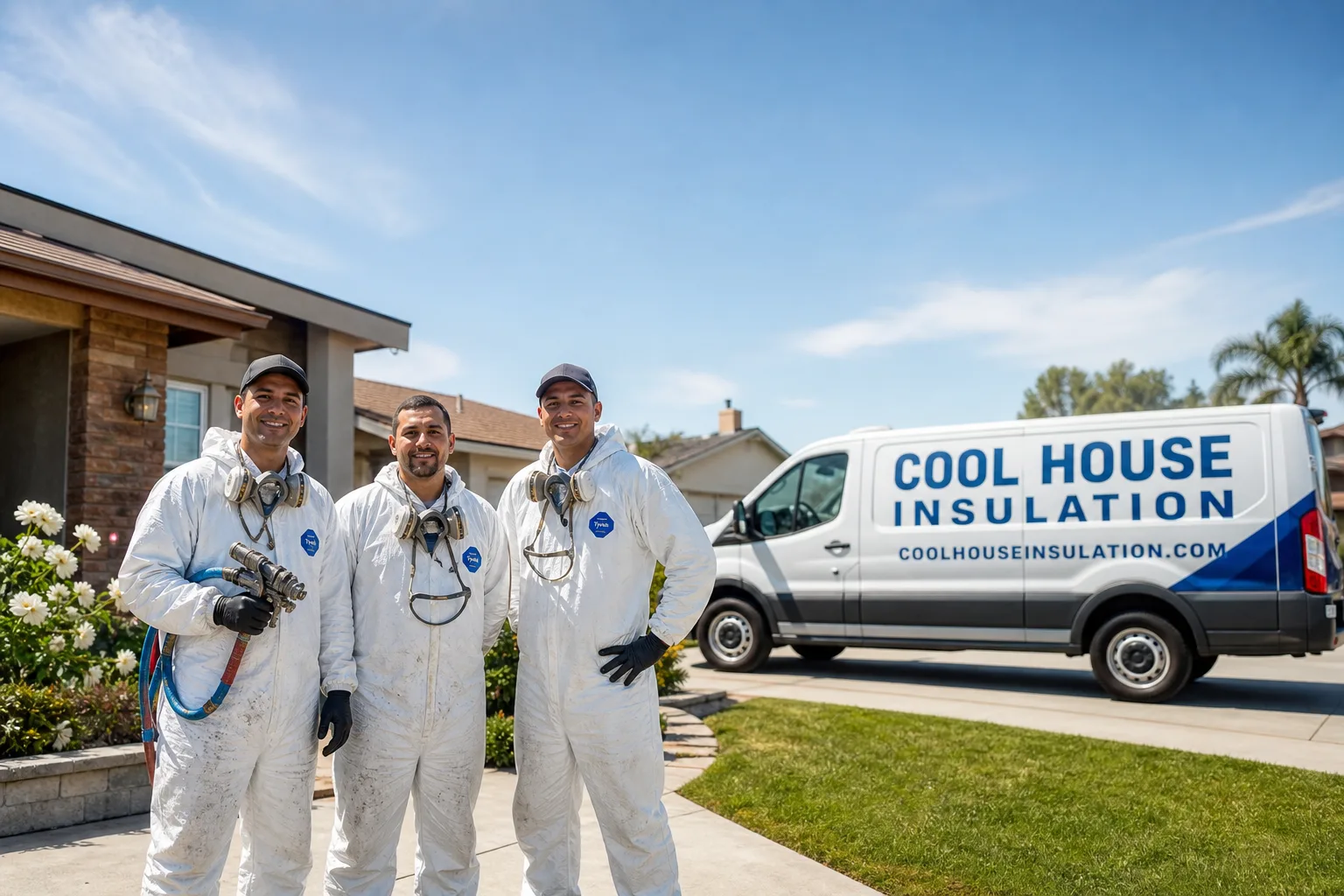
Fast, Reliable Spray Foam Insulation Across Huntington Beach
Spray foam insulation in Huntington Beach costs $2.50 to $6.50 per square foot installed depending on whether the job calls for open-cell or closed-cell foam, and rim joist work typically runs $1,800 to $3,400 for an average home. That’s the short answer. The longer answer matters more here than it does in most cities, because Huntington Beach’s salt air and daily marine layer attack insulation in ways inland Orange County crews never see. Our vans roll into the 92646, 92647, and 92648 grids nearly every weekday. We know these homes. Call (855) 341-7810 when you’re ready to talk about what your attic or crawl space actually needs.
How Huntington Beach’s Salt Air and Marine Layer Wreck Insulation
Walk through the low-slung tracts off Yorktown Avenue or up toward Ellis Avenue in 92647 on a June morning and you’ll see it: fog rolling in off the Pacific, everything damp by 8 a.m. That marine layer is a constant presence roughly 10 months out of the year for homes west of Beach Blvd. It’s also the single most important factor in how spray foam performs, fails, or saves a home here. The local insulation conversation in Huntington Beach should start with moisture and vapor management, then get to R-value second. A closed-cell spray foam job with properly detailed vapor handling will outperform a thicker, less thoughtfully installed product every time in this climate.
In the 1950s and 1960s ranch homes that make up much of the 92646 and 92648 grids, shallow attics leave little room for error. Daily marine-layer condensation drips onto fiberglass batts, matting them down to half their rated R-value within a few years. Vent screws rust. Fasteners corrode. The first sign is usually a musty smell upstairs or visible rust on the attic vents from the outside. That’s not an exaggeration. It’s the pattern we see on nearly every first inspection. The fix is rarely just “add more insulation.” It’s removing the failed material, addressing the moisture entry points, and installing spray foam that can actually handle a humid, salty environment.
In a 1960s ranch off Yorktown Avenue in 92646, our crew found the original fiberglass batts matted and moldy from years of fog drip, with rusted attic vent screws and a corroded rim joist. We removed the failed insulation, applied closed-cell spray foam to the rim joist and attic deck, and replaced the vents with stainless-steel models to stop the salt-air corrosion cycle. That job is the kind of work you can’t template. A technician who only knows inland attics would have blown in some fiberglass and called it a day. That home needed a coastal specialist. You can read more about how our Spray Foam Insulation approach works, but the short version is: we diagnose the house in front of us, not the one from a sales script.
Why Cool House Insulation Is the Right Fit for Huntington Beach Homes
We’re not a one-product contractor pushing whatever we happen to stock. Cool House Insulation is authorized to install products from eight manufacturers, and that matters when your Huntington Beach attic has a specific problem. The right material might be closed-cell spray foam for its moisture-barrier properties and structural rigidity. It might be open-cell foam where airflow and cost-efficiency are the bigger concerns. We carry both Icynene and Demilec, two of the most trusted names in spray foam performance, because Huntington Beach homes regularly need both across different applications. The product choice follows the diagnosis. Not the other way around.
Noel Carrasco has built this company around the idea that insulation is a materials problem with a materials answer. That means bringing the right product to the right room of the right house. Rim joists along a crawl space that gets damp marine air every morning need a closed-cell product that stops both air and moisture. An attic with corrosion-prone roof sheathing needs proper vapor detailing before a single inch of foam goes in. We’d rather tell you what you don’t need than sell you something you’ll regret in three years.
Our crews are in Huntington Beach regularly, including the neighborhoods around Edison High School, Murdy Park, and the downtown 92648 corridor. We know the difference between a 1958 ranch on a raised foundation and a 2000s infill build on slab. Both need insulation. They don’t need the same insulation. Response time for a free Huntington Beach estimate is typically 1 to 3 business days, and we schedule service visits with enough time to do the job right rather than racing to the next stop. Call (855) 341-7810 and we’ll get you on the calendar.
Key takeaways for Huntington Beach homeowners:
- Salt air and fog drip corrode attic vents, fasteners, and rim joists faster than inland Orange County homes.
- Closed-cell spray foam handles Huntington Beach’s humidity and moisture far better than fiberglass in most tight, shallow attics.
- Diagnosis comes first. The right brand and material follow.
- We install Icynene and Demilec spray foam, Rockwool for fire-resistance and soundproofing, and Knauf for thermal performance when batt insulation makes more sense.
- Free estimates with same-week scheduling in most Huntington Beach zip codes.
Rim Joist Spray Foam in Huntington Beach
Rim joist spray foam in Huntington Beach is the single highest-impact insulation upgrade most coastal homeowners haven’t had done. The rim joist, also called the band joist, is the wood framing that sits on top of the foundation where the floor meets the walls. In a 1960s ranch in 92647 or a raised-foundation home near Worthy Park, this area leaks air year-round. Open the crawl space access door on a foggy morning and you’ll feel damp outside air moving through. Closed-cell spray foam seals the rim joist against air and moisture in one pass. A typical Huntington Beach home runs $1,800 to $3,400 for rim joist work depending on crawl space access, linear footage, and how much corrosion cleanup is needed first.
Homes west of Beach Blvd need this first
For any home within about two miles of the Pacific, the rim joist is the first place we inspect for salty air intrusion. Corroded rim joists in older beachside homes prevent proper bonding of spray foam, which means even a well-intentioned insulation job fails. Addressing this before attic work is standard practice in the 92648 zip code.
What the job involves on older HD homes
We inspect the rim joist for rust, rot, and failed wood. Then we clean or replace corroded sections, check that the sill plate is sound, and apply closed-cell foam to seal the full band. On homes where the rim joist is too far gone, we flag it before applying anything. A foam job on compromised wood is wasted money.
Crawl Space Spray Foam Insulation in Huntington Beach
Crawl space spray foam insulation in Huntington Beach is often the difference between a damp, musty house and one that holds steady temperature and humidity year-round. In the 92646 and 92648 grids where many of the original 1950s and 1960s homes sit on raised foundations with vented crawl spaces, that vented design works fine in dry inland air and fails in coastal humidity. The vents allow fog-saturated air to pour in every morning. It condenses on joists, on ductwork, on the underside of the subfloor. Spray foam, particularly closed-cell, stops air movement through the rim joist and crawl space walls. Typical crawl space spray foam in Huntington Beach runs $2,800 to $7,500 depending on square footage, clearance height, and whether the space needs vapor barrier replacement.
Mold prevention is a big part of this
When marine air moves through a crawl space continuously, surfaces stay wet enough for mold to settle in. Closed-cell spray foam does not feed mold the way fiberglass or cellulose can when they get damp. Sealing the space properly removes the moisture path. In homes where we find visible mold, insulation comes second. The moisture source gets addressed first.
Closed-cell vs open-cell in crawl spaces
For most crawl space applications in Huntington Beach we recommend closed-cell spray foam. It acts as a vapor retarder, blocks air, adds structural strength to joists, and does not absorb water. Open-cell has a role in attic applications. In a crawl space under a beach-adjacent home, closed-cell is usually the clear answer. We’ll tell you if it isn’t.
Spray Foam Roof Deck Applications Here
On homes where the attic is converted or conditioned, spray foam roof deck insulation creates an unvented attic assembly. That’s a specific application we do regularly in Huntington Beach because many of the 1980s-2000s two-story infill homes have tight envelope designs that benefit from it. It moves the thermal boundary from the attic floor to the roofline. The complication in a marine-layer climate is that improper vapor detailing can cause closed-cell foam to delaminate from roof sheathing. That’s not a generic warning. We’ve seen it happen in less carefully installed predecessor jobs in Huntington Beach. It happens when someone treats an unvented coastal attic like an inland one. The sheathing temperature swings differently here, and the humidity load is higher. We address this from the start with methodical vapor barrier work before foam application.
Trusted Brands We Install in Huntington Beach
We’re authorized to install spray foam from Icynene and Demilec, the two names we reach for most often in Huntington Beach applications. Closed-cell Demilec foam handles the crawl spaces and rim joists on salt-exposed homes. Icynene open-cell performs well in attics where airflow and cost per square foot matter more than a moisture barrier. For projects where a hybrid approach makes sense, we also install Rockwool for fire-resistance and acoustic control, and Knauf batts where a targeted thermal upgrade fits. Carrying multiple brands means we match the product to your home’s actual needs, not to our inventory sheet. We keep common materials staged for Huntington Beach jobs, which means shorter lead times for most residential projects. For the Spray Foam Insulation in Huntington Beach market, that sort of brand-agnostic flexibility is the difference between a recommendation you can trust and a sales pitch.
Common Problems We See in Huntington Beach Homes
- Corroded attic vents and fasteners: Salt air eats through standard zinc hardware in 7 to 10 years. When vents rust and loosen, gaps form and marine air moves straight into the attic. We replace them with stainless-steel models before insulating anything.
- Matted and moldy fiberglass in shallow attics: Daily condensation wets the batts, they compress, and the R-value drops off a cliff. A 1960s home that originally held R-30 often tests around R-11 after a decade of fog exposure.
- Foam delamination from roof sheathing: When a previous contractor skipped vapor barrier work on an unvented attic assembly, the closed-cell foam can pull away from the wood. We’ve had to remove and redo several of these in Huntington Beach over the last year.
- Corroded rim joists that won’t take foam: Rusted, softened wood can’t bond with spray foam. We’ve seen raised-foundation homes near the wetlands where the rim joist needed partial replacement before any insulation work could happen.
Pricing for Spray Foam Insulation in Huntington Beach, CA
Open-cell spray foam in Huntington Beach attics typically runs $2.50 to $4.00 per square foot installed. Closed-cell runs $4.00 to $6.50 per square foot, with crawl spaces and rim joists at the higher end due to access and prep. A full rim joist job on an average Huntington Beach home lands between $1,800 and $3,400. A typical crawl space runs $2,800 to $7,500. What moves the number: crawl access clearance, how much corrosion remediation is required, whether a vapor barrier gets replaced, and how much of the existing insulation needs removal first. We are not the cheapest contractor in Huntington Beach, and we won’t try to be. What we do is quote the real job, including the coastal corrections other crews miss until it’s too late. Call (855) 341-7810 for a free estimate with real numbers.
We Also Serve Cities Near Huntington Beach
Cool House Insulation runs crews to Huntington Beach and the surrounding coastal Orange County communities every week. The same salt air and marine layer that shape our Huntington Beach projects apply in Westminster, Fountain Valley, Midway City, and Costa Mesa. If you’re in one of those cities and dealing with damp insulation or corrosion in your attic or crawl space, call (855) 341-7810. The coastal diagnosis process is the same.
Serving Huntington Beach, CA — Our Local Coverage Area
We’re based in the Huntington Beach area and know this community well. Use the map below to see our service coverage — if you’re nearby, we can almost certainly help.
FAQs About Spray Foam Insulation in Huntington Beach
Salt air corrodes the metal components around your insulation rather than the foam itself, which is why Huntington Beach attics lose performance through rusted vents and fasteners that let humid marine air move into the insulated space. If you’re also dealing with damaged radiant barrier materials, we offer Reflectix repair in Huntington Beach as part of our coastal remediation services. The daily marine layer condensation then works on whatever insulation is present, matting fiberglass or challenging spray foam’s bond to roof sheathing when vapor barriers are poorly detailed. We address this by upgrading fasteners, re-detailiing the vapor path, and using closed-cell foam where moisture resistance matters most. Call (855) 341-7810 and we’ll inspect your attic for the coastal failure patterns most contractors never look for.
Homes west of Beach Blvd sit close enough to the Pacific that the humid onshore airflow and morning fog reach your crawl space and rim joist daily for most of the year, which means a vented crawl space is pulling in salt-heavy, moisture-heavy air all night. The rim joist is the largest air leak in that equation. Sealing it with closed-cell spray foam is the single best move for homes in that zone. It stops both air movement and moisture intrusion and it strengthens the joists against the corrosion the salt air has already started. Our inspections in 92646 and 92648 routinely find rim joists that need remediation before anything else gets done.
Closed-cell spray foam does not feed mold and it blocks the air and moisture paths that let mold get established in a crawl space, so yes, it’s one of the strongest tools available for mold prevention in coastal crawl spaces. But the order of operations matters. If visible mold is already present, that gets remediated first. The foam seals the envelope and removes the chronic moisture problem that kept the mold coming back. Call (855) 341-7810 to schedule a crawl space inspection and get specific numbers for your home.
Musty smells upstairs, visible rust on attic vents, rooms that never seem to hold temperature, and higher than expected energy bills are the four signs we hear most often from Huntington Beach homeowners before they call. In this coastal environment, moisture is usually the underlying driver. That’s what makes spray foam the right answer more often here than in inland cities. A visual inspection tells us more in 30 minutes than a phone description or a guess ever will.
We recommend an inspection every 3 to 5 years for Huntington Beach homes, primarily because the salt air and marine-layer conditions accelerate wear on the vents, fasteners, and other metal components around your insulation long before the foam itself degrades. A quick inspection catches loose vents, early corrosion, or a developing vapor problem while it’s cheap to fix. Every Huntington Beach home west of Beach Blvd should stay on a regular inspection rhythm. Call (855) 341-7810 and we’ll get you on the schedule.
Cool House Insulation serves all of Huntington Beach, including the neighborhoods around the 92615, 92646, 92647, and 92648 zip codes. Whether you’re in a 1950s ranch near Main Street or a newer build along the Santa Ana River border, the insulation answer starts with the house in front of us. Call (855) 341-7810 for honest advice and a fair, specific estimate.
Written by Noel Carrasco, Owner at Cool House Insulation, serving Huntington Beach and surrounding coastal Orange County communities.