
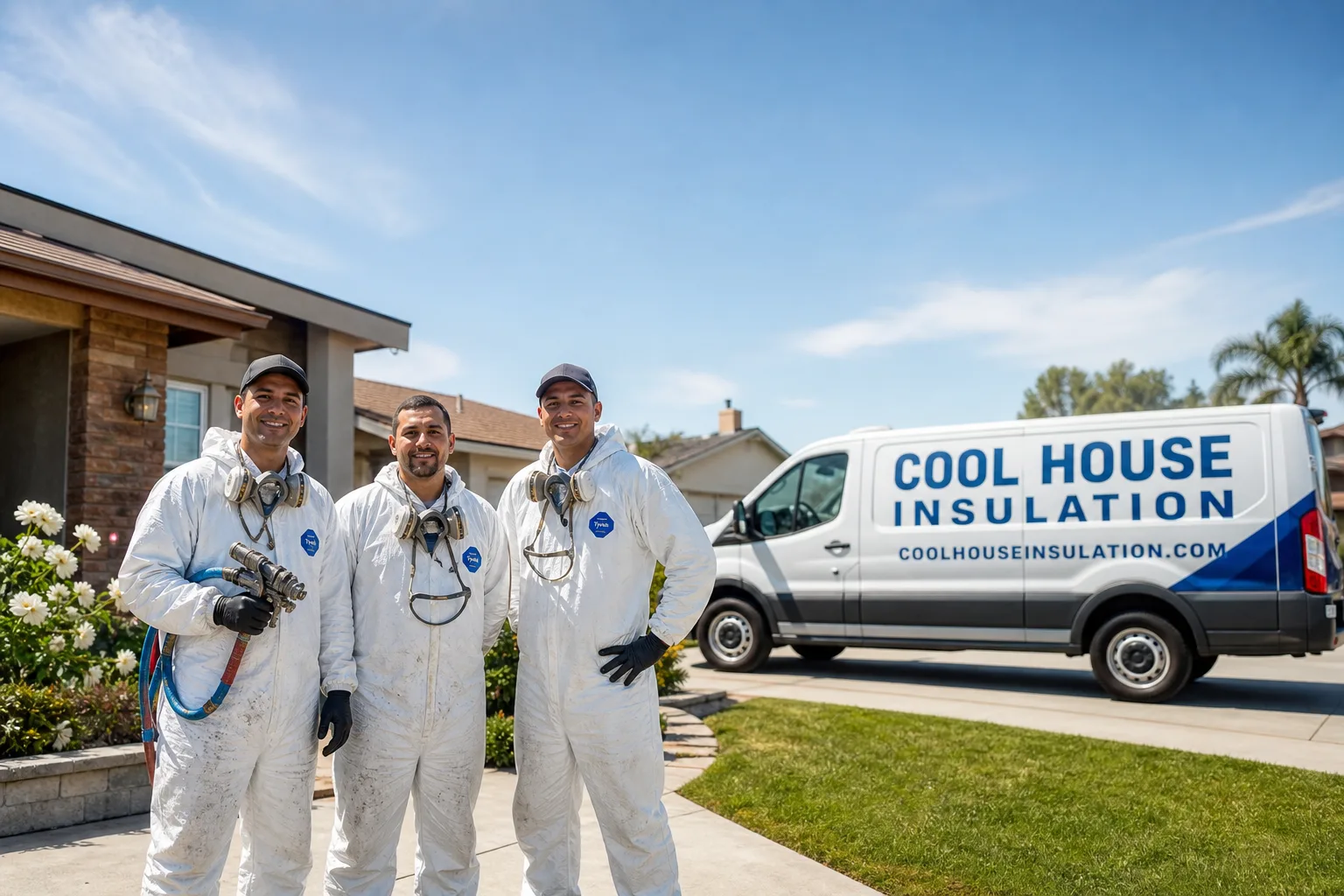
Fast, Reliable Spray Foam Insulation Across East San Gabriel
Spray foam insulation in East San Gabriel typically costs $2.40 to $5.10 per board foot for open-cell and $3.10 to $6.90 per board foot for closed-cell, with most homes in the 91776 zip code falling between $3,800 and $11,600 depending on attic size and whether old rock wool needs removal first. Our crews reach East San Gabriel jobs within 24 to 48 hours, and we know exactly what these postwar attics throw at you. If you live off San Gabriel Blvd or in the tracts between Valley Boulevard and Las Tunas Drive, we’ve likely worked a house just like yours. Call (855) 341-7810 and we’ll come out, pop the hatch, and tell you honestly what your attic needs before anyone sprays a thing.
Why Cool House Insulation Is East San Gabriel’s Preferred Spray Foam Insulation Company
We didn’t pick East San Gabriel as a service area by accident. Noel Carrasco built Cool House Insulation around a simple observation: homes in this part of the San Gabriel Valley aren’t like the newer builds in Arcadia or Temple City. They’re tighter, older, and more particular. That’s why our team has spent hundreds of hours in 91776 attics specifically, mapping how heat moves through 1950s center-hall layouts and postwar bungalows with shallow rafter bays. When a homeowner on a narrow lot near Marshall Fundamental School tells us upstairs rooms hit 88°F by 4pm, we don’t guess. We’ve measured it. We’ve fixed it. And we’ve got the repeat referral business in East San Gabriel to prove it.
Our brand lineup is the other reason. We carry both Icynene and Demilec spray foam systems, which matters because not all foam behaves the same in a 2×4 rafter cavity. Icynene’s open-cell product expands gently and won’t bow old plaster ceilings the way a high-expansion closed-cell can. Demilec’s closed-cell foam, meanwhile, gives us real R-value per inch when headroom’s tight and you can’t add depth. Most single-brand contractors walk into a 1950s East San Gabriel attic and install whatever they sell. We walk in and select the foam that matches the framing, the heat load, and the homeowner’s budget.
Response time matters when your attic’s baking at 130°F. Our East San Gabriel calls get a same-day callback and typically a visit within two days. Estimates are free, and Noel signs off on every project load we schedule in 91776.
Open Cell Spray Foam in East San Gabriel
Open Cell Spray Foam in East San Gabriel is the workhorse for these older attics because it expands to fill odd-shaped post-and-beam cavities and seals air gaps in one pass, running $2.40 to $5.10 per board foot installed. On a typical 1,000-square-foot attic floor at 5.5 inches deep, that lands between $4,200 and $6,800. The foam firms up in about 20 minutes and off-gasses for roughly 24 hours before the space is fully usable again.
How We Handle Rafter Bays and Ceilings
In homes off San Gabriel Blvd with 2×4 rafters, we apply open-cell at the roofline rather than the floor. That keeps your attic as conditioned space and stops radiant heat from ever reaching the ceiling drywall. We’ve measured a 12°F drop in upstairs bedroom temps after a single roofline application.
Where Open-Cell Makes Sense in 91776
Open-cell is the right call when your attic needs air sealing but you also want to add R-value without tearing out old framing. Because it’s vapor-permeable, it tolerates the minor roof deck moisture that older East San Gabriel homes sometimes carry. It’s not the pick for a crawlspace or rim joist near ground contact, but for attics and walls in this climate, it solves the real problem.
Spray Foam Insulation Contractors in East San Gabriel
Spray Foam Insulation Contractors in East San Gabriel who understand these houses are rare, and that’s why homeowners keep calling Cool House Insulation after other bids go sideways. A proper spray foam job here isn’t a simple blow-and-go. It starts with finding what’s already up there, often compressed rock wool from the Eisenhower era, and deciding whether it stays or goes. We quote both ways and explain the tradeoffs before work begins.
What a Full Install Looks Like
We schedule a half-day for most 900 to 1,400 square foot attics in East San Gabriel. The crew lays protection from hatch to soffit, air-seals top plates and penetrations with a closed-cell bead, then sprays the open-cell to spec. You get a photo set before the hatch goes back on, plus the R-value sticker for the framing.
Licensing, Insurance, and the Paperwork Buyers Want
We’re fully licensed and insured for work across Los Angeles County, and when you sell a house in East San Gabriel, having documented R-value upgrades from an established contractor matters. Buyers here ask. We give you the paperwork.
Trusted Brands We Service in East San Gabriel
Cool House Insulation is authorized to install both Icynene and Demilec spray foam, which means East San Gabriel homeowners aren’t forced into a single chemistry. Icynene’s open-cell line is our go-to for 2×4 rafter bays where gentle expansion prevents plaster cracks. Demilec’s closed-cell delivers higher R-value per inch when attic depth is limited or you’re conditioning a garage ceiling. We also carry CertainTeed and GreenFiber for fiberglass and blown-in work, so if we inspect your attic and foam isn’t actually the best move, we’ll say so and quote the alternative. We hold local stock of both foam systems and common trim accessories, which shortens turnaround for East San Gabriel jobs from weeks to days.
Common Spray Foam Insulation Problems We See in East San Gabriel Homes
- Foam sprayed over settled rock wool without air sealing. In 1950s tracts off San Gabriel Blvd, old rock wool is often compressed to 2 inches and packed with dust. If you spray foam directly over it, the wool blocks adhesion and traps heat below the new layer. The foam eventually delaminates, leaving gaps you can’t see. The fix starts with removal or air sealing, not more foam.
- High-expansion foam bowing shallow 2×4 rafters. We’ve repaired ceilings in East San Gabriel where a previous contractor used a heavy-expansion closed-cell in a 3.5-inch cavity. The pressure bulged the drywall and hairline-cracked plaster ceilings in living rooms below. Low-expansion open-cell avoids this entirely, and it’s the reason we match foam chemistry to framing depth.
- Baffles missing at the eave, leading to soffit blockage and roof deck condensation. Older East San Gabriel homes often have minimal eave overhangs. Without baffles, spray foam covers the soffit vents, trapping warm moist air against the roof deck. We install foam baffles before spraying and verify airflow path stays open. Skipping this means condensation and, eventually, sheathing rot.
- Homeowners misreading East San Gabriel’s heat problem as “add more insulation.” The real enemy in 91776 isn’t thin insulation. It’s unsealed air movement through top plates, can lights, and plumbing penetrations. On a July afternoon with attic temps over 130°F, that superheated air drops into wall cavities and heats the house all night. We always air seal before adding R-value, in that order.
Pricing for Spray Foam Insulation in East San Gabriel, CA
A typical open-cell attic application in East San Gabriel runs $4,200 to $7,400 for a 1,000 to 1,500 square foot home, while closed-cell at a 3-inch depth lands between $5,800 and $9,800. Rim joist work on a crawlspace home runs $900 to $2,200, and conditioning a detached garage ceiling adds $1,600 to $3,400 depending on roof area. If we have to remove settled rock wool first, expect $1.50 to $3.00 per square foot in added prep cost, including debris disposal. East San Gabriel’s pricing tracks slightly below Pasadena and San Marino because our trucks run a shorter route from the 710 corridor, but materials are identical to what we install anywhere. Get a free, line-item quote by calling (855) 341-7810. Noel will walk the attic with you if you’re home, and there’s no pressure on the spot.
We Also Serve Cities Near East San Gabriel
Our crews cover East San Gabriel daily, and we work the surrounding San Gabriel Valley cities including San Gabriel, Rosemead, Alhambra, and San Marino. If you’re in a neighboring community with the same postwar framing and heat load, our Spray Foam Insulation team can usually roll your project into the same week. Call us for scheduling across the 91776 area and nearby zip codes.
Serving East San Gabriel, CA — Our Local Coverage Area
We’re based in the East San Gabriel area and know this community well. Use the map below to see our service coverage — if you’re nearby, we can almost certainly help.
FAQs About Spray Foam Insulation in East San Gabriel
Yes. We use low-expansion open-cell spray foam, typically Icynene, in 2×4 rafter bays because it won’t bow the drywall or crack plaster ceilings the way high-expansion closed-cell can. R-13 at full cavity depth is achievable, and when we spray the roofline we can reach R-20 to R-22 without adding depth. On a narrow lot near San Gabriel Blvd, we opened a hatch to find original 1950s rock wool compressed to 2 inches and no baffles, with attic temps over 130°F. We air-sealed all top plates and penetrations with closed-cell spray foam, then added open-cell foam to the roofline to reach R-22 without sacrificing headroom. The homeowner reported the upstairs bedroom dropped from 88°F to 76°F on a 98°F day. Call (855) 341-7810 and we’ll tell you what’s possible in your specific attic.
Usually yes, especially in East San Gabriel homes where that rock wool has settled to 2 inches or less and is loaded with decades of dust. Spraying foam over compressed rock wool prevents adhesion, traps heat, and leads to delamination. We quote removal at $1.50 to $3.00 per square foot including bagging and disposal. It’s an added cost, but skipping it wastes the foam job you’re about to pay for.
Yes, but only if air sealing happens first. In July, attics in the 91776 tracts between San Gabriel Blvd and Valley Blvd routinely exceed 130°F. Spray foam at the roofline cuts that dramatically, but if top plates, can lights, and plumbing penetrations stay unsealed, that hot air still migrates into wall cavities. We seal everything before spraying. That sequence is the difference between a marginal improvement and a 10 to 15 degree drop in the rooms below.
Spray foam air-seals while it insulates, which fiberglass batts do not. In a 1950s bungalow with no baffles and shallow rafter cavities, fiberglass leaves gaps at every bay edge and does nothing to stop air movement. Spray foam fills and seals simultaneously. The tradeoff is cost: fiberglass runs roughly $1.50 to $2.50 per square foot installed, while spray foam runs $2.40 to $6.90 per board foot depending on open- or closed-cell. For most East San Gabriel attics, foam is the better long-term buy, but we’ll quote fiberglass or blown-in GreenFiber if your home doesn’t actually need foam. Call us at (855) 341-7810 and we’ll give you real numbers for both options.
Yes, with standard precautions. During spraying, the home is ventilated and occupants, including pets, should stay out for roughly 24 hours while the foam cures and off-gasses. After that, cured spray foam is inert and does not release VOCs. We use low-VOC Icynene and Demilec products, and we mask and protect the work area through the entire process. If you have a household member with chemical sensitivities, tell us during the estimate and we’ll adjust ventilation and re-entry timing accordingly.
Written by Noel Carrasco, Owner at Cool House Insulation, serving East San Gabriel and the San Gabriel Valley.