
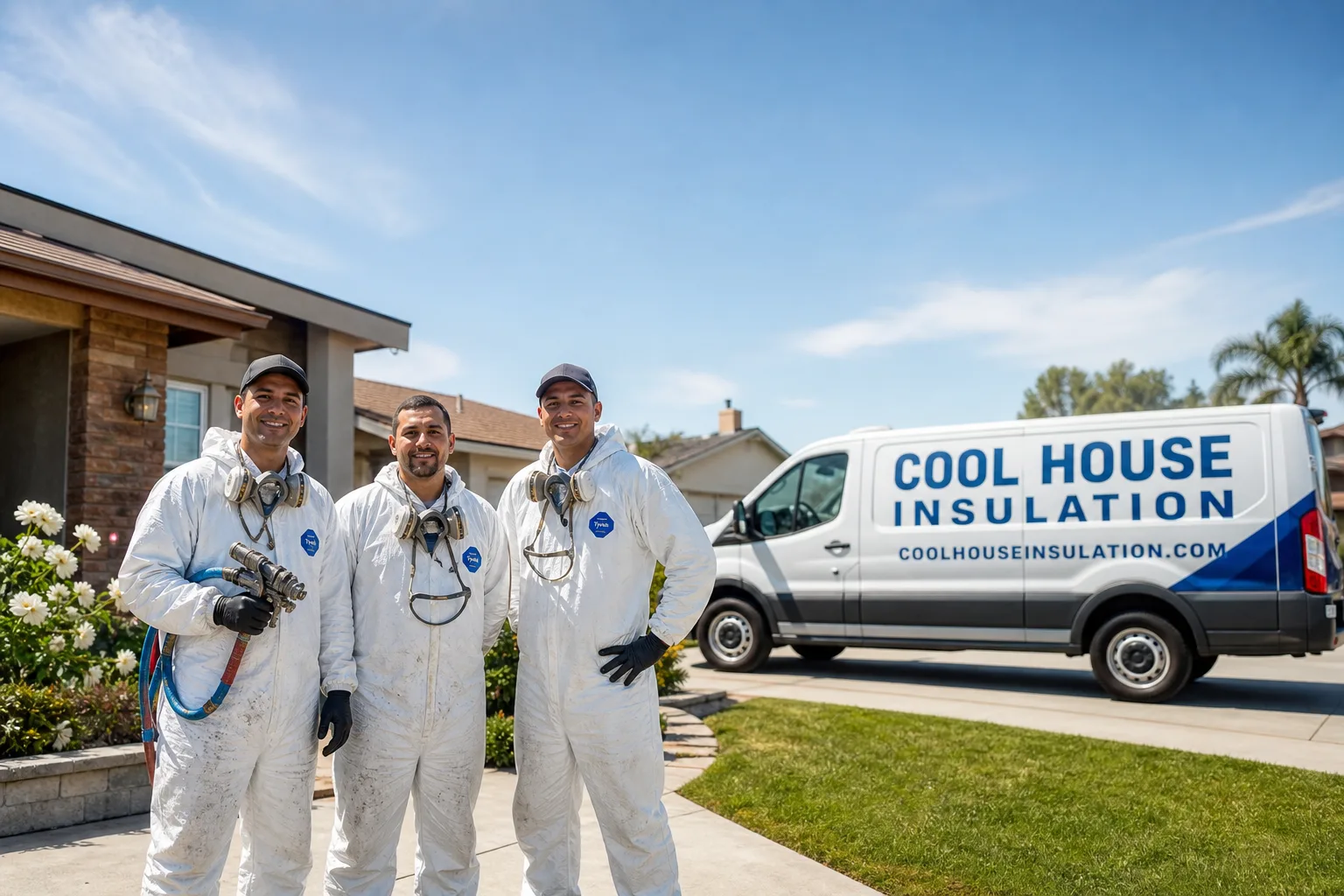
Fast, Reliable Attic Insulation Across Whittier
Attic insulation in Whittier typically costs $1.35 to $3.10 per square foot installed, depending on whether you’re topping up existing material or starting from zero. Most homes in the 90601 through 90612 ZIP codes run on the higher end of that range because we’re usually pulling out old, compressed fiberglass or dealing with knob-and-tube wiring that needs air sealing before anything gets blown in. Our crews are in Whittier weekly, often same-day for estimates, and a full attic retrofit on a 1,200-square-foot ranch usually takes one day. Call (855) 341-7810 if you want a straight answer on what your attic needs.
We know this city’s attics. Not the way a map knows them. The way a crew knows them after crawling through a hundred of them. Whittier’s pre-1970s housing stock is a different animal from what you find in La Mirada or Santa Fe Springs. More original lath and plaster. More low-pitch ranch ceilings where you can barely sit up. More wiring that predates Romex. That’s the work we’re built for.
Why Cool House Insulation Is Whittier’s Preferred Attic Insulation Company
Whittier homeowners call us because we carry eight insulation brands and we’re not married to any of them. Most insulation crews in this area work with one manufacturer. They’ll sell you what they stock, whether or not it’s the right fit for a 1954 ranch on Hadley Street or a 1960s tract home near Michigan Park. That’s backwards. We start with the attic itself. The heat load, the access points, the existing material, the wiring. Then we pick the product that solves the problem. Sometimes that’s GreenFiber blown-in cellulose because it fills the weird cavities in a Whittier Hills home better than batts ever could. Sometimes it’s Rockwool batts because you want the fire resistance and sound deadening on a busy street off Whittier Boulevard. Sometimes open-cell Icynene foam makes sense for a low-pitch roof where we can’t get enough depth for loose fill.
Having access to eight manufacturers, including CertainTeed, Demilec, and Owens Corning, means the recommendation you get is for your house, not for our inventory. That’s the whole reason Cool House Insulation exists. We’d rather lose a sale than blow the wrong material into your attic and let the Santa Anas cook your upstairs for another decade.
Whittier residents also like that we show up when we say we will. A lot of insulation work in this city happens on weekends, because the access issues on 1950s ranches mean the homeowner wants to watch what we’re doing. We get that. We’re happy to walk you through what’s up there before we touch anything. Noel Carrasco runs the operation with a simple rule: if we wouldn’t put it in our own attic, we don’t put it in yours.
Attic Insulation Removal in Whittier
Attic insulation removal in Whittier is a regular job for us, mostly because so many of the city’s 1920s through 1960s homes have never been touched since the original install or have material that’s been flattened, rodent-soiled, or rendered useless by decades of Santa Ana dust and heat bake. A full removal on a typical 1,100-square-foot Whittier attic runs $1,200 to $1,800, and we handle haul-off same day. If there’s knob-and-tube wiring present, the old insulation has to come out carefully around those ceramic posts, which adds labor but prevents a fire hazard.
You need removal before new insulation when any of these apply: the old material is compressed below its rated R-value, there’s evidence of rodent or raccoon activity, there’s moisture staining from a past roof leak, or you’re doing a rewire and the electrician needs clear access. In Whittier’s older homes off Philadelphia Street and up in the hills, we see all four. Most of that original fiberglass was installed at R-11 or less back when energy was cheap. Today it’s doing almost nothing.
Removal Methods That Work Here
We use a HEPA-filtered negative-air vacuum rig sealed at the attic access, which keeps dust from migrating through your plaster ceilings and into the living space. On low-pitch ranches where attic access is tight, we stage the equipment through an eaves vent or a widened hatch and work in sections so the hose never kinks. The process on a standard Whittier bungalow takes four to six hours, most of it spent reaching the far ends of the attic from a plank board, because those old ceilings were never meant to hold a grown man’s weight without reinforcement.
What We Find During Removal
Open soffit bays are the biggest surprise on Whittier’s mid-century homes. The original builders ran vent slots directly into the attic and never screened them, so the new insulation we remove is often wind-washed and full of leaves. We flag those bays during removal and seal them before anything new goes in. That’s the difference between a re-insulation that works for twenty years and one that underperforms in its first Santa Ana season.
Insulation Contractors in Whittier
Insulation contractors in Whittier come in two flavors: the ones who sub out the work to whoever’s cheap and free that week, and the ones like us who keep the same crew on every job. The difference shows up in the details. Did they baffle the soffit vents before blowing? Did they build a dam around the attic hatch so cellulose doesn’t spill into the hallway? Did they check for knob-and-tube contact before letting the blower rip? Those details are why a Whittier homeowner needs a contractor who’s done this exact work in this exact housing stock, not a generalist who learned on new construction in Irvine.
A full attic insulation project from us, including removal if needed, air sealing, baffling, and new material, runs $2,800 to $5,400 on a typical Whittier home. Top-ups when the existing material is in decent shape run $1,400 to $2,300. We’ll give you a hard number before we start, and that number is what you pay. No surprise change orders because we didn’t see the attic until demo day, which is how most underbids work around here.
What Our Whittier Crews Actually Do
We start with the attic. Always. Not a sales quote from a patio table. We open the hatch, we get up there, we measure joist depth, check venting, look for wiring hazards, test the existing R-value, and check for moisture in the decking. Then we write the quote based on what we saw. On Whittier’s 1950s ranches where the hatch is 20 inches square and you can’t stand up, that first look takes longer than the insulation itself sometimes. We don’t rush it, because what we find changes the material recommendation.
Working in Tight Whittier Attics
The low-pitch ranch attic is the hardest working space in Whittier real estate, and most of them were never designed for a person to work in them. We use plank bridges, knee pads, and headlamps, and we work in rotating shifts so nobody spends four hours bent at a 40-degree angle. If your attic access is too narrow for our blower hose, we’ll widen the hatch cleanly, install a proper attic ladder frame if you want one, and leave the opening sealed and insulated so you’re not losing conditioned air through the cover all year.
Trusted Brands We Service in Whittier
We install and service insulation from eight manufacturers, and for Whittier’s mix of 1920s bungalows and 1950s tract homes, we lean on a few more than others. Rockwool batts come up a lot in Whittier because of the fire resistance on older homes where electrical predates modern grounding. CertainTeed fiberglass is a workhorse for standard attic top-ups where budget is the priority and the venting is already correct. Icynene and Demilec open- and closed-cell foams appear on our Whittier quotes for low-slope roofs and attic conversions where traditional vented insulation won’t fit the code requirements. We stock the common materials locally and can have specialty products from any brand ordered for your specific attic in under a week. You’re never stuck with whatever’s on someone’s warehouse floor.
Common Attic Insulation Problems We See in Whittier Homes
- Zero insulation in pre-1970s attics – huge swaths of Uptown Whittier and South Whittier were built before California’s energy code required attic insulation, which means a 1954 ranch off Hadley Street can have nothing but roof sheathing between the summer sun and your ceiling. We routinely find attics where the only “insulation” is a half-inch of settled dust.
- Compressed, wind-washed original fiberglass – in the tract homes east of Painter Avenue and around Michigan Park, the original R-11 batts have been walked on, flattened by storage, and matted down by decades of heat. Compressed fiberglass loses most of its R-value, but homeowners don’t know until the upstairs won’t cool below 82 in August.
- Knob-and-tube wiring crossing insulation bays – Whittier’s older neighborhoods still have active knob-and-tube circuits in ceilings and walls. Blowing cellulose over those ceramic knobs without air sealing and clearance work creates a real fire risk, and we see it every month. The wiring has to be assessed before material goes down.
- Unsealed attic hatches and soffit bays – the narrow attic hatches on 1950s ranches and the open soffit vents on Whittier’s bungalows leak conditioned air year-round. You can blow R-38 over the whole attic, and if the hatch is uninsulated and the soffits are open, you’ll still feel the Santa Ana heat radiating through the ceiling on a 95-degree day.
Pricing for Attic Insulation in Whittier, CA
A full attic insulation replacement in Whittier, including removal of old material, air sealing, baffling, and new blown-in cellulose or fiberglass, runs $2,800 to $5,400 for most homes under 1,500 square feet. A top-up over existing insulation runs $1,400 to $2,300. If you want Rockwool batts for fire resistance on an older home, expect $2.25 to $3.10 per square foot. Spray foam, most often used here for low-slope or vaulted attics, runs $3.50 to $6.50 per board foot for open-cell and closed-cell respectively. These are Whittier market prices, not national averages. Call (855) 341-7810 and we’ll give you an exact number after we’ve seen your attic. Estimates are free, and you’ll get the range in writing before we leave.
We Also Serve Cities Near Whittier
Our crews work the whole Whittier area, including Attic Insulation in Whittier and every neighborhood around it. We’re regularly in South Whittier, West Whittier-Los Nietos, East La Mirada, and Santa Fe Springs. If you’re a homeowner or a builder anywhere in this corridor, you’re within our normal service area, and you’ll get the same pricing structure and the same crew. Learn more about our full Attic Insulation capabilities or call us to schedule an attic inspection this week.
Serving Whittier, CA — Our Local Coverage Area
We’re based in the Whittier area and know this community well. Use the map below to see our service coverage — if you’re nearby, we can almost certainly help.
FAQs About Attic Insulation in Whittier
Whittier attics need air sealing before new insulation because the city’s pre-1970 homes were built with open soffit bays, unsealed top plates, and attic hatches that leak air directly into the conditioned space. Blowing insulation over those gaps without sealing them lets warm air bypass the material entirely, which cuts the effective R-value by up to half. We seal top plates, wiring penetrations, and the hatch perimeter before any new material goes in. Call (855) 341-7810 to have us check yours.
Yes, we do it weekly. The narrow 20-inch hatches on Whittier’s 1950s ranches don’t fit standard blower rigs or even some workers’ shoulders, so we widen the hatch opening cleanly, do the work, and rebuild the frame with a sealed, insulated cover when we’re done. If you’re planning to use the attic for storage afterward, we’ll frame for a proper ladder while we’re at it. Call us at (855) 341-7810 to schedule an access assessment.
Yes, and the difference is measurable. Whittier sits inland of the Whittier Narrows, so summer afternoons run five to ten degrees hotter than coastal LA cities, and Santa Ana wind events push attic temperatures past 140 degrees on a 95-degree day. Coastal homes get afternoon marine relief; your attic doesn’t. The same R-38 that works fine in Long Beach underperforms in Whittier, which is why we calculate heat load for Whittier specifically rather than using a generic LA spec. Call (855) 341-7810 and we’ll walk you through the numbers for your street.
We install blown-in cellulose from GreenFiber, blown-in and batt fiberglass from CertainTeed and others, Rockwool mineral wool batts, and open- and closed-cell spray foam from Icynene and Demilec. The right material for your Whittier house depends on roof pitch, existing venting, wiring condition, and whether you want fire resistance, sound control, or maximum thermal performance per inch. We’ll show you the options with real prices and let you decide. Call (855) 341-7810 for a free attic consultation.
We remove old insulation whenever it’s compressed, contaminated by rodent activity, wet from a past roof leak, or working against the new material. On Whittier homes where the original fiberglass is matted to half its labeled R-value, leaving it in place wastes the new insulation’s performance. A full removal runs $1,200 to $1,800 on a typical Whittier attic, and we haul everything off same day. Call (855) 341-7810 and we’ll tell you honestly whether removal is worth it in your case.
Written by Noel Carrasco, Owner at Cool House Insulation, serving Whittier and greater Los Angeles with attic insulation, blown-in, and spray foam expertise.